
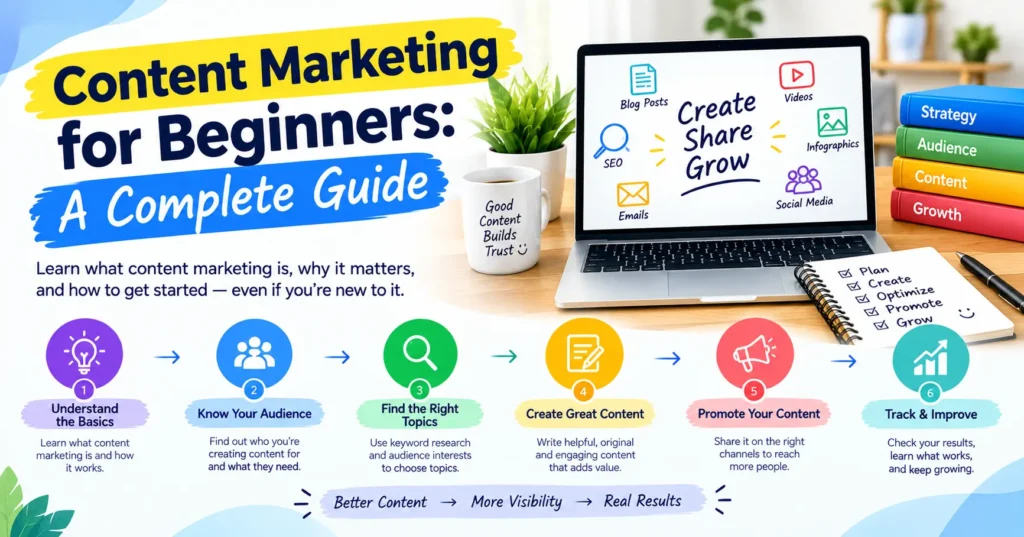
Content marketing is one of the most useful ways for businesses, bloggers, and online publishers to attract an audience. Instead of relying only on advertisements, content marketing focuses on creating helpful information that answers questions, solves problems, and builds relationships with readers.
A business might publish blog posts to explain its services, create videos to demonstrate a product, or send newsletters that help customers make informed decisions. Each activity can serve a different purpose, but the best content provides genuine value to its intended audience.
If you are new to digital marketing, understanding content marketing can help you plan better articles, improve your website, and communicate more effectively with potential customers.
This guide explains what Content Marketing for Beginners, why it matters, how to develop a strategy, and how to measure results.
What Is Content Marketing?
Content marketing is the process of creating and distributing relevant, useful content for a clearly defined audience to support specific business or communication goals.
Common content formats include:
- Blog posts and educational articles.
- Step-by-step tutorials.
- Videos and demonstrations.
- Infographics and visual guides.
- Email newsletters.
- Case studies based on genuine results.
- Downloadable resources and templates.
- Podcasts and interviews.
For example, a company that provides website design services could publish a guide explaining how to choose a website platform. The article helps readers understand their options while demonstrating the company’s knowledge.
Content marketing is not simply publishing as much material as possible. It requires understanding your audience, selecting relevant topics, maintaining quality, and making the content accessible to the people who need it.
Why Is Content Marketing Important?
It Answers Audience Questions
People often research a problem before choosing a product or service. Helpful content allows a business to address those questions before a customer makes a decision.
A website hosting company, for example, might explain the differences between shared hosting and cloud hosting.
It Supports Search Engine Optimization
Useful articles can attract visitors from relevant search queries. Organizing related content into a clear website structure also helps readers discover additional information.
Content alone does not guarantee search rankings. Pages still need to satisfy user intent and be accessible to search engines.
It Builds Trust
Clear explanations, accurate information, original examples, and transparent communication can help readers assess whether a publisher understands its subject.
Avoid exaggerated claims and unsupported statistics. Trust is easier to build when content is honest about its limitations.
It Supports Multiple Marketing Channels
One useful guide can become the basis for several related materials. A detailed article might provide ideas for a short video, an email newsletter, or a social media post.
Each format should be adapted to its audience rather than copied without considering how people use the platform.
It Can Provide Lasting Value
An evergreen guide may continue helping readers long after publication if it remains accurate and relevant. Regular reviews can identify outdated information, broken links, and opportunities to improve the article.
How to Create a Content Marketing Strategy
A content marketing strategy connects the content you create with the needs of your audience and the goals of your website or business.
Step 1: Define Your Goals
Start by deciding what you want your content to achieve.
Possible goals include increasing relevant website traffic, generating qualified enquiries, educating customers, growing an email audience, or helping existing customers use a product.
Choose a goal that you can measure. For example, a publisher might track organic search clicks, while a service business might monitor qualified enquiries generated by educational articles.
Step 2: Understand Your Audience
Identify the people you want to help.
Consider their questions, challenges, level of knowledge, interests, and preferred content formats. You can gather information through customer feedback, interviews, website search data, community discussions, and keyword research.
Avoid assuming that every visitor has the same needs. A beginner may need a basic explanation, while an experienced reader may want advanced examples or comparisons.
Step 3: Research Content Topics
Create a list of questions and subjects related to your website’s main categories.
For a digital marketing publication, topics might include SEO, social media marketing, email campaigns, content planning, and advertising.
Use keyword research tools to discover relevant search phrases, but examine the actual search results to understand what people expect from a page.
Prioritize topics that fit your audience and that you can cover accurately and usefully.
Step 4: Choose the Right Content Formats
Different topics work better in different formats.
A detailed tutorial may suit a blog article. A product demonstration may be easier to understand in a video. A comparison of several options may work well as a table supported by explanatory text.
Choose formats based on the information you need to communicate and the resources available to you.
Step 5: Build Topic Clusters
Organize related articles around a main subject.
For example, a content marketing cluster could include:
- A complete beginner’s guide to content marketing.
- A guide to developing a content strategy.
- A tutorial on building a content calendar.
- An article about measuring content performance.
- A guide to repurposing existing content.
The main guide can introduce the subject and link to more detailed articles. Supporting pages can link back to the main guide and to other relevant resources.
This approach creates a more useful reading experience than publishing unrelated articles without clear connections.
Step 6: Create an Editorial Calendar
An editorial calendar helps you manage your content consistently.
For each planned article, record its title, target audience, primary keyword, search intent, category, writer, status, and intended publication date.
For example, a small publisher might plan two or three articles per week, depending on the time available for research, writing, editing, and publishing.
The schedule should be realistic. Publishing fewer strong articles is preferable to rushing out large quantities of weak or repetitive content.
Step 7: Create and Edit the Content
Before writing, define the reader’s main question and the outcome the article should deliver.
Use a clear structure with descriptive headings. Explain unfamiliar terms, include useful examples, and provide practical steps where appropriate.
Before publication, check factual claims, links, spelling, image quality, and mobile readability. Add original insights rather than simply repeating information available elsewhere.
If you use AI tools to assist with drafting, review the output carefully and take responsibility for the accuracy and usefulness of the finished article.
Step 8: Distribute Your Content
Publishing an article is only one part of the process. Make it accessible through relevant channels.
Depending on your audience, you might share a guide through social media, include it in a newsletter, link to it from related website pages, or reference it in customer communications.
Do not distribute content indiscriminately. Choose channels where your intended readers are likely to find it useful.
Step 9: Measure and Improve
Use suitable analytics and feedback to understand whether the content is achieving its purpose.
Useful metrics may include organic search clicks, engaged visits, newsletter sign-ups, enquiries, conversions, and reader feedback.
The most appropriate metric depends on the goal. A guide intended to educate readers may serve a different purpose from a landing page designed to generate enquiries.
Review results periodically and update content when information becomes outdated or the audience’s needs change.
Common Content Marketing Mistakes
Several mistakes can reduce the value of a content marketing program.
Publishing without a plan: Random topics make it difficult to build a coherent resource library.
Focusing only on keywords: Search terms are useful for understanding audience needs, but the article must still provide a satisfying answer.
Copying competitors: Reproducing another website’s work does not create distinctive value for readers.
Ignoring distribution: Useful content may receive little attention if the intended audience cannot find it.
Failing to update older articles: Outdated instructions and broken links can reduce usefulness and credibility.
Measuring the wrong outcomes: Traffic alone may not indicate whether content is supporting your actual goals.
Conclusion
Content marketing helps businesses and publishers communicate with their audiences through useful articles, videos, guides, newsletters, and other resources.
To get started, define your goals, understand your readers, research relevant topics, create a realistic publishing schedule, and organize related content into clusters. Then distribute your work through appropriate channels and measure meaningful results.
The objective is not simply to publish more content. It is to build a useful library of information that readers can trust and return to when they need help.
FAQs
What is content marketing in simple terms?
Content marketing means creating useful information for a particular audience to educate, help, or engage people while supporting a broader business or communication goal.
Is content marketing the same as SEO?
No. SEO helps people discover relevant pages through search engines, while content marketing focuses on creating and distributing useful content. They can support each other.
How often should I publish new content?
There is no universal ideal frequency. Choose a schedule that allows sufficient time for research, writing, editing, and maintaining existing content.
Can a small business do content marketing with a limited budget?
Yes. A small business can begin with useful blog articles, existing customer questions, a basic editorial calendar, and free measurement tools.