
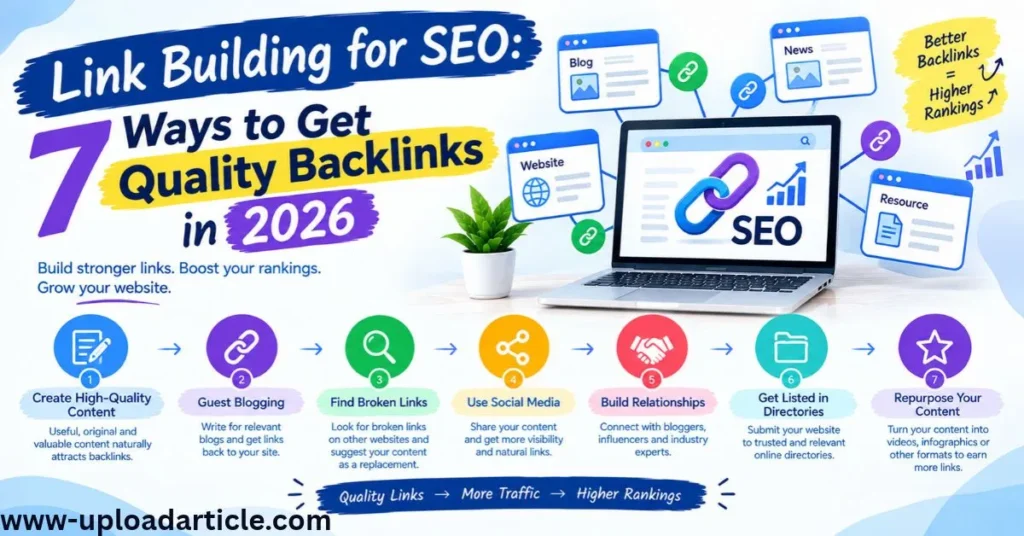
Link building for SEO is the process of earning links from other websites to your own. These links, commonly called backlinks, can help people discover your content and provide search engines with additional context about relationships between web pages.
However, not all backlinks are equally useful. A relevant editorial link from a trustworthy website may help readers find valuable information, while a large number of irrelevant or manipulated links can create risk without providing meaningful benefits.
Successful link building focuses on useful content, genuine relationships, and legitimate reasons for another website to reference your page.
This guide explains how backlinks work, how to find link opportunities, and how to build a sustainable strategy.
What Is Link Building in SEO?
Link building is an off-page SEO activity intended to earn links from external websites.
For example, imagine that you publish an original guide to website security. A technology blog discovers the guide and links to it as a resource for its readers. That link is a backlink to your website.
Backlinks can serve several purposes:
- Help visitors discover relevant resources.
- Send referral traffic to your website.
- Help search engines discover pages.
- Provide context about the content being referenced.
- Potentially contribute to search ranking systems when the links are appropriate and editorially earned.
A backlink does not guarantee higher rankings. Search engines consider many signals, including relevance, content quality, and the overall context in which a link appears.
Why Are Quality Backlinks Important?
They Can Help People Discover Your Website
When another website links to a useful page, its readers may visit your website to learn more. This referral traffic can be valuable even when it does not directly lead to a sale.
They Can Support Content Discovery
Links can help search engine crawlers find pages, particularly when those pages are not easily reached through other links. A well-organized website should still provide clear internal navigation and an XML sitemap where appropriate.
They Can Strengthen Your Reputation
When a respected publication references your original research or practical guide, readers may view your website as a useful resource. The value depends on the relevance and credibility of the source, not merely on a numerical SEO metric.
They Can Support Your Wider SEO Strategy
Link building works best alongside useful content, technical accessibility, clear site structure, and good user experience. It cannot compensate for a website filled with inaccurate, unhelpful, or inaccessible pages.
What Makes a Good Backlink?
There is no single metric that determines whether a backlink is valuable. Evaluate opportunities using several factors.
Relevance
A link from a website covering a related subject is often more meaningful to your audience than a link from an unrelated website.
For example, a digital marketing guide may naturally receive links from SEO publications, business blogs, or educational resources.
Editorial Context
A link placed naturally within relevant content can help readers explore a subject in greater detail. Links created only to manipulate rankings are much riskier.
Website Quality
Review whether the linking website publishes useful content, maintains a clear editorial purpose, and appears to serve real readers.
Do not judge a website solely by a third-party authority score. Such scores are estimates, not official Google ranking metrics.
Placement and Usefulness
A link should make sense where it appears. Ask whether the link genuinely helps the reader understand the subject or find a useful resource.
Natural Anchor Text
Anchor text is the clickable text of a link. It should describe the destination naturally and accurately.
Avoid repeatedly demanding the exact same commercial keyword as anchor text across many websites. A natural backlink profile can include brand names, page titles, descriptive phrases, and ordinary references.
Seven Ethical Ways to Build Backlinks
Publish Original Research
Original data can give other publishers a reason to reference your website.
For example, a digital marketing website could conduct a transparent survey about content creation habits or analyze a clearly described dataset. Explain the methodology, limitations, and findings.
Do not invent statistics or present unsupported estimates as verified research.
Create Useful Guides and Resources
Detailed guides, checklists, templates, glossaries, and educational resources can attract links when they answer questions effectively.
A resource should offer real value beyond what readers can easily find on every competing page.
Use Digital PR
Digital public relations involves sharing newsworthy information, research, expert commentary, or useful resources with relevant journalists and publications.
Identify publications that genuinely cover your subject. Personalize your outreach, explain why your information is relevant, and respect editorial decisions.
Avoid mass-emailing unrelated websites with generic requests.
Contribute Expert Articles
Some publications accept guest contributions from knowledgeable writers. A legitimate contribution should meet the publication’s editorial standards and provide original value to its readers.
Do not use guest posting primarily to place keyword-rich backlinks. Paid or sponsored placements should be handled transparently and with appropriate link attributes under applicable search engine guidelines.
Find Unlinked Brand Mentions
Sometimes a website mentions your brand or resource without linking to it.
You can contact the publisher politely, identify the relevant mention, and ask whether adding a link would help readers. The publisher is free to decline.
Replace Broken Resources When Appropriate
A page may link to a resource that no longer exists. If you have a genuinely useful replacement, you can inform the website owner.
The replacement should serve the same purpose as the original resource. Do not assume that every broken link is an opportunity to promote an unrelated page.
Build Relationships in Your Industry
Participate constructively in relevant professional communities, collaborate on legitimate projects, and share useful information.
Relationships may lead to natural mentions and references over time. Avoid exchanging links purely to manipulate search rankings or creating large-scale reciprocal link arrangements.
How to Find Link-Building Opportunities
A practical process makes outreach more focused.
Step 1: Identify your strongest pages. Choose original research, detailed guides, useful tools, or other resources that deserve references.
Step 2: Research relevant websites. Look for publications, professional organizations, resource pages, and blogs that cover the same subject.
Step 3: Review the existing content. Understand what the website publishes and whether your resource would add something useful.
Step 4: Record your findings. Keep a spreadsheet with the website, contact details when publicly available, the relevant page, the reason for outreach, and the date of contact.
Step 5: Send personalized outreach. Explain the specific connection between your resource and the publisher’s content.
Step 6: Follow up respectfully. One polite follow-up may be appropriate. Avoid repeated messages or pressure tactics.
Step 7: Evaluate outcomes. Track acquired links, referral visits, relevant relationships, and the performance of the pages being promoted.
Example of a Link-Building Outreach Email
Subject: Useful resource for your article about website security
Hello,
I was reading your article about website security and found it useful for beginners.
I have also published a guide that explains practical website security measures, including account protection, software updates, and safer website management. I thought it might be a useful additional resource for readers who want to explore the topic further.
Here is the guide: [Insert your relevant page URL]
Please feel free to review it if it fits your article. Thank you for your time.
Best regards,
[Your Name]
Personalize this message for each recipient. Only send it when the resource is genuinely relevant.
Common Link-Building Mistakes to Avoid
Buying Links to Manipulate Rankings
Paying for links intended to influence search rankings can violate search engine spam policies. Paid advertising and sponsorships should be disclosed and use appropriate link attributes where required.
Using Private Blog Networks
Networks of websites created primarily to manipulate rankings can expose a site to search engine actions and waste resources. Focus on earning genuine editorial references instead.
Publishing Low-Quality Guest Posts at Scale
Publishing large quantities of generic articles solely for backlinks may create little audience value and can introduce risk.
Using Automated Link Spam
Automatically posting links in comments, forums, directories, or other websites can create spam and damage your reputation.
Chasing Metrics Instead of Relevance
A high third-party authority score does not automatically make a link suitable. Consider the website’s topic, editorial quality, audience, and the usefulness of the link.
Ignoring Internal Links
External backlinks are only one part of SEO. Internal links help readers and crawlers navigate related pages on your own website. Use descriptive internal links to connect relevant articles and important pages.
How to Measure Link-Building Results
Measure the quality and outcomes of your work rather than counting backlinks alone.
Useful indicators include:
- Number of relevant, legitimate referring websites.
- Referral traffic from acquired links.
- Engagement and conversions from referral visitors.
- Search visibility for relevant pages and topics.
- New relationships with publishers and industry organizations.
- Whether links remain available and continue to serve readers.
Google Search Console can help you review links reported for your website and monitor search performance. Third-party SEO tools can provide additional estimates, but their databases may be incomplete.
Ranking changes can have many causes. Do not assume that a single backlink caused a particular improvement.
A Simple 30-Day Link-Building Plan
Week 1: Prepare your content. Review existing articles and improve one or two pages that offer genuine value.
Week 2: Research prospects. Create a list of relevant websites, publishers, and resource pages.
Week 3: Begin outreach. Send a small number of personalized messages explaining why your resource fits each website.
Week 4: Review and improve. Follow up appropriately, record responses, and refine your content or outreach approach based on what you learn.
This is a starting framework, not a guarantee of acquiring links within a particular period.
Conclusion
Link building for SEO is most sustainable when it helps real people discover useful information. Create resources worth referencing, identify relevant publishers, conduct respectful outreach, and evaluate links based on their context and usefulness.
Avoid shortcuts based on spam, artificial link networks, or ranking manipulation. A thoughtful strategy built around quality content and legitimate relationships can support your website’s wider SEO efforts over time.
FAQs
How many backlinks does a website need to rank?
There is no universal number. Competition, relevance, content quality, technical accessibility, and many other factors affect search visibility. Focus on earning useful links instead of pursuing a fixed target.
Are backlinks still important for SEO?
Links can help people discover content and provide useful context to search engines. Their impact varies, and no backlink guarantees a ranking improvement.
What is the difference between internal links and backlinks?
Internal links connect pages on the same website. Backlinks are links from external websites pointing to your website.
How long does link building take?
The timeline varies. Research, content creation, outreach, and editorial decisions may take time, and results are not guaranteed.
Can new websites build backlinks?
Yes. New websites can earn links by publishing original, useful resources and building genuine relationships. Start with realistic goals and prioritize quality.