
Search engines play an important role in how people discover businesses, compare products, and find solutions to their problems. For companies that want to attract customers online, understanding search behavior is essential. However, simply publishing content or running advertisements is not enough. Businesses also need reliable information to understand what people are searching for, how competitors attract visitors, and which marketing activities produce the best results.
This is where search engine marketing intelligence becomes valuable.
Search engine marketing intelligence involves collecting, analyzing, and using search-related information to make better marketing decisions. It can help businesses understand customer search intent, identify keyword opportunities, evaluate competitors, improve advertising campaigns, and measure search performance.
Whether you manage a small business website, an online store, or a digital marketing agency, search marketing intelligence can help you make decisions based on evidence instead of assumptions.
In this guide, we explain what search engine marketing intelligence means, how it works, which tools can support it, and nine practical strategies for using search data to improve your marketing performance.
What Is Search Engine Marketing Intelligence?
Search engine marketing intelligence is the process of gathering and analyzing information about search behavior, keywords, competitors, advertisements, and website performance to improve marketing strategies.
It helps businesses understand how people search for information and how websites compete for visibility in search engine results.
The information can support both major areas of search marketing:
- Search Engine Optimization (SEO): Improving a website’s visibility in unpaid search results.
- Paid Search Advertising: Using advertisements to reach people searching for relevant products, services, or information.
Marketing intelligence can help businesses answer important questions:
- What keywords are potential customers searching for?
- Which topics receive attention from search users?
- What type of content matches a particular search?
- Which competitors appear for valuable keywords?
- How much are businesses spending on paid search campaigns?
- Which landing pages attract visitors and generate conversions?
- Where are the best opportunities to improve performance?
For example, an online store selling office furniture may discover that customers search for “best office chair for back support” before purchasing. This information can help the business create a useful buying guide and plan relevant advertising campaigns.
The purpose is not simply to collect data. It is to turn useful information into better marketing decisions.
Why Is Search Engine Marketing Intelligence Important?
Search marketing is competitive. Businesses often compete for the same keywords, audiences, and advertising opportunities.
Without research, a company may target irrelevant keywords, create content that does not match customer needs, or spend its advertising budget on searches that produce few valuable results.
Search engine marketing intelligence helps reduce these problems.
Understand Customer Search Behavior
Search data can reveal what people want to learn, compare, or purchase.
For example, someone searching for “what is website hosting” may need educational information, while someone searching for “buy website hosting plan” may be closer to making a purchase.
Understanding this difference helps businesses create more relevant pages and campaigns.
Identify Keyword Opportunities
Keyword research helps businesses discover relevant search terms and understand their potential value.
A company may find opportunities in specific, detailed search phrases that larger competitors have not covered well.
Understand Competitors
Competitor research can show which websites appear for relevant searches, what topics they cover, and how they position their products or services.
This information can help businesses identify content gaps and improve their own marketing plans.
Improve Advertising Decisions
Paid search data can help advertisers understand which keywords, advertisements, and landing pages generate useful results.
This makes it easier to evaluate campaign spending and identify areas that need improvement.
Measure Marketing Performance
Analytics can help businesses evaluate organic traffic, paid clicks, conversions, and other important measurements.
Instead of relying only on assumptions, marketing teams can use performance information to decide what to improve next.
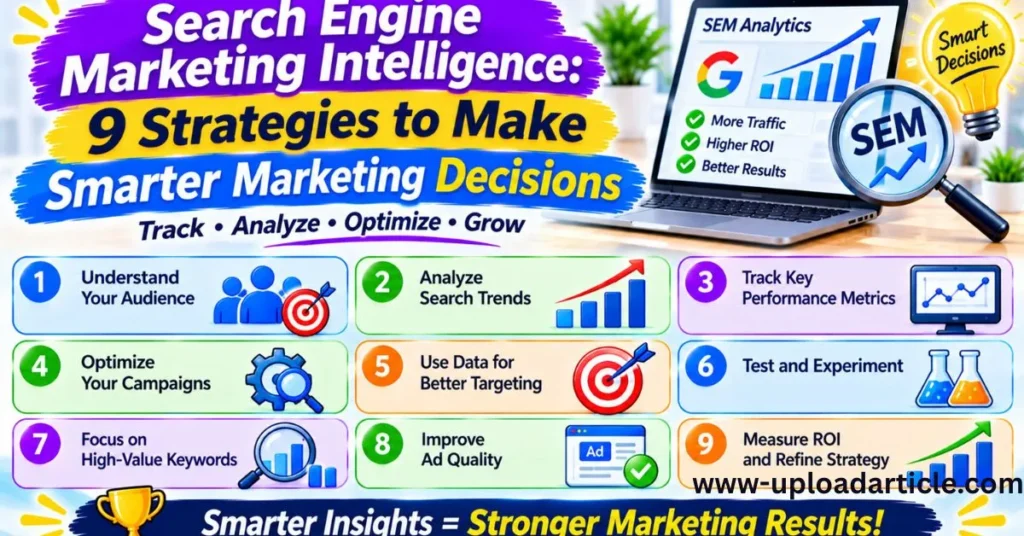
Nine Strategies for Using Search Engine Marketing Intelligence
A practical search marketing intelligence strategy combines research, analysis, planning, and continuous improvement.
Here are nine useful approaches.
1. Conduct Detailed Keyword Research
Keyword research is one of the foundations of search engine marketing intelligence.
It helps businesses identify the phrases people use when searching for products, services, and information.
Start by listing topics related to your business. Then use keyword research tools to discover relevant search terms, search demand, competition, and related queries.
For example, a business offering website design may research:
- Website design services.
- Website design for small businesses.
- How much does a business website cost?
- Professional website designer.
- Website redesign services.
Do not select keywords based on search volume alone. Consider search intent, relevance, competition, and the likelihood that the keyword will attract the right audience.
Practical tip: Organize keywords into topic groups and assign each group to a suitable page or article.
2. Analyze Competitor Search Performance
Competitor intelligence helps businesses understand how other websites compete for search visibility.
Start by identifying websites that appear regularly for your important keywords. Examine their content, page structure, titles, topics, and search visibility.
Useful questions include:
- Which topics do competitors cover?
- Which pages appear to attract search traffic?
- What questions do their articles answer?
- Are there useful topics they have missed?
- How do they describe their products or services?
- What type of content appears in search results?
SEO platforms such as Semrush and Ahrefs can help analyze competitor keyword visibility and backlink profiles.
However, competitor data is generally an estimate, not a complete record of another company’s private analytics or advertising account.
Use it to identify opportunities rather than copy another website’s content.
3. Understand Search Intent
Search intent refers to the purpose behind a user’s search.
Understanding intent helps businesses create pages that match what people actually want.
Common search intent categories include:
Informational intent: The user wants to learn something.
Example: “What is search engine marketing?”
Navigational intent: The user wants to find a particular website or page.
Example: “Google Search Console login.”
Commercial investigation: The user is comparing options before making a decision.
Example: “Best SEO tools for small businesses.”
Transactional intent: The user is ready to take an action, such as purchasing a product or hiring a service.
Example: “Hire an SEO agency.”
A page that does not match search intent may struggle to satisfy visitors, even if it targets a relevant keyword.
Practical tip: Search your target keyword and examine the types of pages appearing in the results. Use that information to understand what users are likely expecting.
4. Monitor Paid Search Advertising Competitors
Paid search intelligence can help businesses understand how competitors promote their products and services through search advertisements.
You can review publicly visible advertisements and use advertising research platforms to investigate available competitor information.
Consider:
- Which products or services competitors promote.
- What messages appear in their advertisements.
- Which offers they emphasize.
- What landing pages they use.
- How their advertisements address customer problems.
For Google Ads, Google’s Ads Transparency Center can help users explore advertisements from advertisers across supported regions and formats.
Remember that publicly visible advertisements do not reveal every detail of a competitor’s campaign. Exact budgets, targeting settings, conversion rates, and private performance data may not be available.
The goal is to understand the market and identify opportunities for your own campaigns.
5. Identify Content Gaps
A content gap exists when your website does not provide information that your target audience is searching for, or when existing pages do not answer their questions effectively.
Search engine marketing intelligence can help identify these gaps.
For example, a website publishing articles about SEO may already cover keyword research and on-page optimization but may not have useful guides about:
- SEO reporting.
- Search intent.
- Website indexing.
- Local SEO.
- SEO content audits.
- Organic search performance.
Competitor research, keyword tools, search suggestions, and customer questions can help identify relevant missing topics.
However, not every keyword needs a separate article. Related questions should often be covered together in one comprehensive resource.
Practical tip: Create a content map that connects related keywords with the most appropriate existing or planned pages.
6. Use Analytics to Measure Search Performance
Analytics helps businesses understand what happens after someone visits their website.
For organic search, Google Search Console provides information about search queries, impressions, clicks, click-through rates, and average positions.
For website activity, Google Analytics 4 can help measure user interactions and configured conversions.
For paid search, Google Ads provides campaign reporting that can include impressions, clicks, cost, conversions, and other advertising metrics.
Important measurements include:
| Metric | What It Helps You Understand |
|---|---|
| Impressions | How often a page or advertisement appears |
| Clicks | How often users select a result or advertisement |
| Click-through rate (CTR) | How frequently impressions result in clicks |
| Average position | An aggregated indication of organic search ranking |
| Cost per click (CPC) | Average advertising cost per click |
| Conversion rate | Percentage of users completing a selected action |
| Cost per conversion | Average advertising cost per conversion |
| Return on ad spend (ROAS) | Revenue attributed to advertising relative to advertising cost |
Do not judge performance using one metric alone. For example, a campaign with many clicks may still be unsuccessful if it generates few valuable leads or sales.
7. Research Local Search Opportunities
Local search intelligence is useful for businesses serving customers in specific cities, regions, or neighborhoods.
A local company may need to understand which services people search for in its target area.
For example, a plumbing business in Austin, Texas, may research phrases such as:
- Plumber in Austin.
- Emergency plumbing service Austin.
- Water heater repair Austin.
- Local plumbing company.
- Drain cleaning service near me.
Local search research can help businesses create relevant service pages, improve their Google Business Profile, and understand local competitors.
Avoid creating large numbers of nearly identical location pages that provide little additional value. Each page should contain useful, accurate information for the location it represents.
8. Evaluate Landing Pages and Conversion Performance
Getting visitors to a website is only one part of search marketing.
A landing page must also provide a useful experience and help visitors complete the intended action.
Search marketing intelligence can help businesses identify pages that receive traffic but do not generate enough inquiries, sign-ups, or purchases.
Review factors such as:
- Page relevance to the search query.
- Headline clarity.
- Content quality.
- Mobile usability.
- Page loading performance.
- Form length.
- Calls to action.
- Trust and contact information.
For example, if an advertisement promotes website design services but sends users to a general homepage, visitors may struggle to find the relevant information.
A dedicated landing page explaining the service, process, and next steps may provide a more relevant experience.
9. Build a Continuous Monitoring and Improvement Process
Search behavior, competitors, customer expectations, and advertising costs can change.
A one-time research project is not enough to maintain a strong search marketing strategy.
Create a regular process for reviewing performance.
A simple schedule might include:
Weekly: Review important campaign performance, advertising spending, and major website issues.
Monthly: Analyze search queries, keyword trends, conversions, and landing page performance.
Quarterly: Review competitors, content gaps, marketing objectives, and budget allocation.
The schedule should match the size of the business and the amount of marketing activity.
Use the findings to update content, test advertising messages, improve landing pages, and adjust priorities.
Best Tools for Search Engine Marketing Intelligence
Several tools can help businesses collect and analyze search marketing information. Each tool has a different purpose, so you do not need to use all of them.
| Tool | Main Purpose |
|---|---|
| Google Search Console | Organic search performance and indexing information |
| Google Analytics 4 | Website activity and conversion analysis |
| Google Ads | Paid search campaign management and reporting |
| Google Keyword Planner | Keyword research and advertising planning |
| Semrush | Keyword research and competitor analysis |
| Ahrefs | SEO research, backlinks, and competitor visibility |
| Microsoft Clarity | Website behavior and user interaction insights |
| Google Trends | Exploring changes in search interest over time |
Google Search Console
Google Search Console helps website owners understand how their pages perform in Google Search.
It can show which queries generate impressions and clicks, identify indexing issues, and provide information about search visibility.
Google Analytics 4
Google Analytics 4 helps businesses understand how visitors interact with their websites.
With suitable configuration, it can measure important actions such as form submissions, purchases, and sign-ups.
Google Keyword Planner
Google Keyword Planner supports keyword research and advertising planning. It provides keyword ideas and estimates that can help advertisers plan campaigns.
Semrush and Ahrefs
These platforms provide SEO research features, including keyword discovery, competitor analysis, and backlink research.
Their traffic and ranking information should be treated as estimates rather than exact measurements of competitors’ private website performance.
Google Trends
Google Trends helps users explore how search interest changes over time and compare interest across different topics and regions.
It can be useful for identifying seasonal patterns and emerging topics.
Search Engine Marketing Intelligence vs. Traditional Marketing Research
Search engine marketing intelligence and traditional marketing research both help businesses understand markets and customers, but they use different types of information.
| Area | Search Marketing Intelligence | Traditional Marketing Research |
|---|---|---|
| Main focus | Search behavior and online visibility | Broader customer and market understanding |
| Data sources | Search queries, analytics, ads, SEO tools | Surveys, interviews, reports, focus groups |
| Keyword research | Major activity | Not usually a central activity |
| Competitor analysis | Search rankings and advertisements | Products, pricing, brand positioning |
| Performance tracking | Clicks, impressions, conversions | Sales, customer opinions, market share |
| Common applications | SEO and paid search planning | Product development and broader business strategy |
The two approaches can complement each other.
For example, customer interviews may explain why people prefer a particular product, while search data may show the exact phrases they use when looking for it.
Combining both sources can provide a more complete understanding of customer needs.
Common Mistakes to Avoid When Using Search Marketing Intelligence
Collecting data does not automatically improve marketing performance. Businesses must interpret it correctly.
Here are some common mistakes.
Focusing Only on Search Volume
A keyword with high search volume may attract visitors who are not interested in your products or services.
Consider relevance and search intent before selecting keywords.
Copying Competitors
Competitor analysis should help identify opportunities, not encourage copying.
Create original content that answers customer questions and offers useful information.
Treating Estimated Data as Exact
Third-party SEO platforms estimate traffic, rankings, and other competitor information.
Do not treat these estimates as verified records of another company’s actual performance.
Ignoring Conversion Data
High traffic and click numbers do not always produce business results.
Track leads, sales, subscriptions, and other meaningful actions.
Using Outdated Information
Old keyword research or competitor reports may no longer represent current market conditions.
Review important data regularly and check whether your decisions remain relevant.
Ignoring Privacy and Data Protection
Marketing analytics should be implemented responsibly.
Follow applicable privacy laws, provide required disclosures, and respect user consent and data protection requirements.
How Small Businesses Can Use Search Engine Marketing Intelligence
Small businesses do not need a large marketing department to benefit from search intelligence.
They can begin with a few practical steps.
Start with customer questions: List the problems customers frequently ask about and identify related search terms.
Use free research tools: Explore Google Search Console, Google Trends, and Keyword Planner where appropriate.
Review competitors: Identify websites appearing for relevant searches and examine their publicly available content.
Create useful pages: Publish articles, service pages, and guides that answer genuine customer questions.
Track important actions: Measure inquiries, purchases, sign-ups, and other meaningful conversions.
Improve regularly: Review results and update pages or campaigns based on evidence.
For example, a small accounting firm could research searches related to tax preparation, bookkeeping, and business accounting. It could then create useful service pages and educational articles targeting the needs of its local audience.
The objective is to focus on relevant opportunities rather than trying to compete for every popular keyword.
How Artificial Intelligence Is Changing Search Marketing Intelligence
Artificial intelligence is changing how marketers research, analyze, and organize information.
AI-powered tools can help marketers summarize large datasets, group related keywords, identify patterns, draft reports, and generate campaign ideas.
For example, a marketing team may use an AI tool to organize a list of search queries into informational, commercial, and transactional categories.
AI can also support competitor research and help identify questions that are not adequately answered by existing content.
However, AI-generated analysis should not be accepted without review.
Marketers should:
- Verify important facts and statistics.
- Check whether data is current.
- Review keyword relevance.
- Avoid publishing inaccurate claims.
- Protect confidential business information.
- Use human judgment when making strategic decisions.
AI is most useful when it supports careful research and decision-making rather than replacing them completely.
Conclusion
Search engine marketing intelligence helps businesses understand the information behind online search behavior and use it to make smarter marketing decisions.
By researching keywords, analyzing competitors, understanding search intent, monitoring advertisements, evaluating landing pages, and measuring performance, companies can improve how they attract and engage potential customers.
The most effective approach is not simply collecting large amounts of data. It is identifying relevant information, understanding what it means, and using it to improve marketing activities.
Whether you manage a small website or a growing business, search engine marketing intelligence can provide a useful foundation for building more informed SEO and paid search strategies.
Frequently Asked Questions About Search Engine Marketing Intelligence
What is search engine marketing intelligence?
Search engine marketing intelligence is the process of collecting and analyzing search-related information, including keywords, competitors, advertisements, and website performance, to make better marketing decisions.
Why is search engine marketing intelligence important?
It helps businesses understand customer search behavior, identify keyword opportunities, evaluate competitors, improve campaigns, and measure marketing results.
What is the difference between SEO and search engine marketing intelligence?
SEO focuses on improving organic search visibility. Search engine marketing intelligence is the research and analysis process that can support SEO, paid search, and broader search marketing decisions.
Which tools are used for search engine marketing intelligence?
Common tools include Google Search Console, Google Analytics 4, Google Ads, Google Keyword Planner, Semrush, Ahrefs, Google Trends, and Microsoft Clarity.
Can small businesses use search marketing intelligence?
Yes. Small businesses can use free and paid tools to research keywords, understand competitors, monitor website performance, and identify useful marketing opportunities.
How does competitor intelligence help search marketing?
It helps businesses understand which topics competitors cover, what keywords they target, how their websites appear in search results, and where useful content opportunities may exist.