
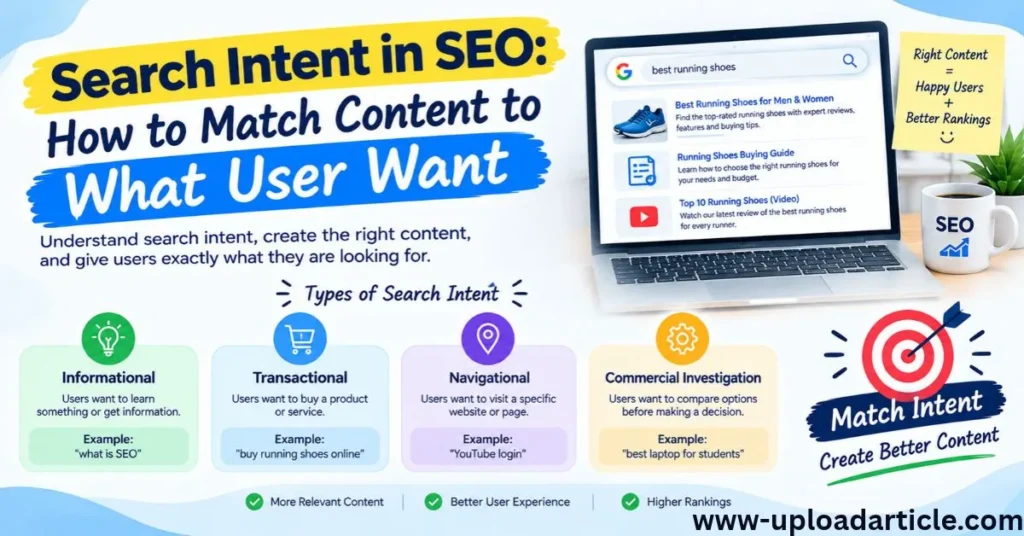
Search engine optimization involves more than finding keywords and adding them to your website. To create content that satisfies users, you also need to understand why people search for particular terms.
This is where search intent becomes important. Search intent in SEO refers to the purpose behind a search query. Someone searching for a definition wants information, while someone searching for a product price may be preparing to make a purchase.
When your content matches the purpose of a search, it has a better chance of providing a useful experience. In this guide, you will learn Search Intent in SEO the main types of search intent, how to identify them, and how to apply search intent research to your SEO strategy.
What Is Search Intent in SEO?
Search intent is the reason a person enters a query into a search engine. The query may be short, but the person usually has a particular question, task, or goal in mind.
Consider these searches:
- What is search engine optimization?
- Best SEO tools for beginners.
- Ahrefs pricing.
- Ahrefs login.
Although these queries relate to SEO tools or search optimization, they represent different needs. The first asks for an explanation, the second requests a comparison, the third concerns pricing, and the fourth suggests that the user wants to access an existing account.
A successful SEO strategy considers both the words people use and the purpose those words communicate.
Why Does Search Intent Matter?
It Helps You Create More Relevant Content
If someone wants a step-by-step tutorial, a short promotional page may not satisfy their needs. Similarly, a person ready to buy a product may prefer a page that clearly presents pricing, features, and purchasing options.
Understanding intent helps you choose an appropriate page format and level of detail.
It Improves the User Experience
Relevant content makes it easier for visitors to find answers without unnecessary searching. Clear headings, direct explanations, and useful examples can help readers complete their tasks.
It Supports Better Keyword Targeting
Two keywords may contain similar words but require different pages. An intent-based approach helps you decide whether to create a tutorial, comparison, service page, or product page.
It Helps Organize Your Website
Grouping pages by the needs they satisfy makes it easier to build logical content clusters and relevant internal links.
Search intent is not a guarantee of rankings. Search engines consider many signals, including relevance, quality, competition, and technical accessibility. Nevertheless, intent is a useful foundation for content planning.
The Four Main Types of Search Intent
SEO professionals commonly organize search intent into four categories: informational, navigational, commercial investigation, and transactional.
Informational Intent
Informational searches happen when users want to learn something or solve a problem.
Examples include:
- What is content marketing?
- How to improve website speed.
- How does keyword research work?
- Why are my website pages not indexed?
The best content formats often include detailed articles, tutorials, beginner guides, explainers, and instructional videos.
When targeting informational intent, answer the main question early. Then provide additional context, examples, steps, and related questions that help readers understand the subject.
For example, a page targeting “how to find long-tail keywords” should explain practical research methods rather than simply define long-tail keywords.
Navigational Intent
Navigational searches occur when people want to reach a specific website, brand, platform, or page.
Examples include:
- Google Search Console login.
- Ahrefs website.
- YouTube.
- WordPress dashboard login.
Users performing these searches often already know where they want to go.
If you operate the website or brand being searched for, make sure your official pages are accessible, clearly labeled, and easy to navigate. Use accurate brand names and descriptive page titles.
If you run an independent information website, do not imply that you are the official destination for another brand. Clearly distinguish your content from the brand’s own website.
Commercial Investigation Intent
Commercial investigation happens when people research options before making a decision.
Examples include:
- Best SEO tools for small businesses.
- WordPress hosting comparison.
- Ahrefs vs Semrush.
- Best laptops for students.
Suitable formats include comparison articles, product roundups, feature breakdowns, review guides, and buying advice.
To create useful commercial content, explain your evaluation criteria. Compare relevant features, limitations, pricing where verified, and intended use cases.
Avoid unsupported claims such as calling a product the best without explaining why. Disclose commercial relationships where required and keep recommendations transparent.
Transactional Intent
Transactional searches indicate that users are ready to complete an action, such as purchasing a product, signing up for a service, or downloading a tool.
Examples include:
- Buy a domain name.
- Purchase website hosting.
- Sign up for an email marketing service.
- Download a specific application.
Pages targeting transactional intent should make the next step clear. Depending on the offering, include accurate pricing, product details, important terms, relevant calls to action, and a straightforward checkout or registration process.
A long educational article may not be the most suitable page for someone who is already ready to purchase.
How to Identify Search Intent Step by Step
Step 1: Research Your Target Keyword
Begin with the keyword you want a page to target. Record the exact phrase and consider what a person using it is likely trying to accomplish.
For example, “SEO meaning” suggests that the user wants a definition. “SEO agency pricing” suggests a comparison of costs or a service decision.
Do not rely on the wording alone, because some queries can have more than one possible intent.
Step 2: Examine the Search Results
Search for your keyword and study the pages that appear prominently.
Look for patterns:
- Are most results educational articles?
- Are they comparison pages?
- Are product or service pages prominent?
- Are there videos, maps, or other search features?
- Do the pages answer a particular question or support an action?
The search results provide clues about the content formats that may satisfy the query. However, rankings can vary by location, device, and time, so treat your observations as evidence rather than an absolute rule.
Step 3: Analyze the Top-Ranking Pages
Review a sample of relevant results. Examine their titles, headings, structure, examples, and the questions they answer.
Identify the shared expectations across these pages. Then look for genuine opportunities to improve the experience through clearer explanations, updated information, better organization, or original examples.
Do not copy competitors’ content. Your objective is to understand the audience’s needs and provide your own useful answer.
Step 4: Determine the Best Content Format
Match the page type to the likely intent.
For example:
- “What is technical SEO?” — educational guide.
- “Best keyword research tools” — comparison or roundup.
- “SEO services for small businesses” — service page.
- “Buy SEO software” — product or purchase page.
If a query has mixed intent, you may need to cover more than one user need or create separate pages for distinct purposes.
Step 5: Build an Outline Around the User’s Goal
Write the main question your page must answer. Use it to determine the introduction, headings, examples, and supporting information.
For informational content, provide the answer early and explain the details afterward. For comparison pages, define evaluation criteria and compare options consistently. For service pages, explain the service, who it helps, how it works, and what the next step involves.
Step 6: Review Your Content After Publishing
Use Google Search Console to examine which queries generate impressions and clicks for your pages.
If the queries differ from your original expectations, review the page and determine whether it addresses the actual needs behind those searches. Improve the content when the evidence supports a change.
Avoid changing a page solely because rankings fluctuate for a short period.
Search Intent and Keyword Mapping
Keyword mapping means assigning target keywords to the most appropriate pages on your website.
A simple table can help you plan:
| Target keyword | Likely intent | Recommended page |
|---|---|---|
| What is content marketing | Informational | Beginner guide |
| Best content marketing tools | Commercial investigation | Comparison article |
| Content marketing agency | Commercial or transactional | Service page |
| Content marketing software pricing | Commercial or transactional | Pricing or product page |
The precise intent may vary, so verify the search results before finalizing your page plan.
Keyword mapping also helps prevent keyword cannibalization, a situation in which multiple pages target substantially overlapping queries and compete to satisfy the same search need.
Not every overlap is harmful, but when two pages serve nearly identical purposes, consider consolidating them or making their roles clearer.
Common Search Intent Mistakes
Targeting a Keyword Without Checking Its Meaning
A keyword may look attractive because of its search volume, but its intent may not match your website or goals.
Creating the Wrong Page Type
A sales page may struggle to satisfy an informational query, while an introductory article may not meet the needs of a ready-to-buy customer.
Copying the Search Results
Competitor analysis helps you understand expectations, but duplicating their structure or wording does not create a distinctive resource.
Overusing Keywords
Repeating a phrase unnaturally does not solve the user’s problem. Write clearly and use related terms where they genuinely fit.
Ignoring Search Intent After Publication
Search behavior and search results can change. Review page performance periodically and update content when there is a clear reason to do so.
Conclusion
Search intent helps you create content around what people actually want to accomplish. By identifying whether a query is informational, navigational, commercial, or transactional, you can choose a suitable page format and develop more relevant content.
Research your keywords, examine search results, map keywords to appropriate pages, and review performance after publication. When your content clearly satisfies a real user need, your website becomes more useful to visitors and better organized for long-term SEO growth.
FAQs
What is search intent in SEO?
Search intent is the goal behind a search query. It helps explain whether a person wants information, a specific website, a comparison, or a way to complete an action.
What are the four types of search intent?
The four commonly used categories are informational, navigational, commercial investigation, and transactional intent.
How can I check search intent for a keyword?
Search for the keyword, review the main results, identify the formats and questions they cover, and determine what kind of page would best satisfy the likely user goal.
Is search intent a ranking factor?
Search engines aim to provide relevant results that satisfy users’ queries. Search intent is an important SEO planning concept, but no single content technique guarantees a ranking.
Can one keyword have multiple search intents?
Yes. A query may have mixed intent, and different users may be looking for different things. Review the search results and consider whether one page can meet those needs effectively.