
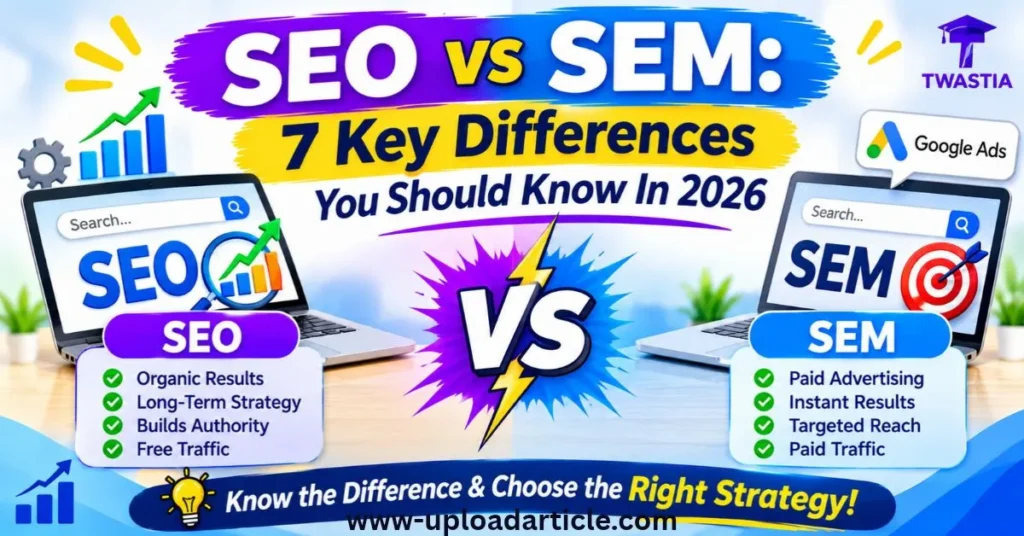
Search engines are among the most important ways people discover websites, products, and services. When someone searches for a question or product on Google, businesses want their websites to appear where potential customers can find them. Two common strategies for improving search visibility are Search Engine Optimization (SEO) and Search Engine Marketing (SEM).
Although these terms are closely related, they are not exactly the same. SEO focuses on improving a website’s visibility in organic search results, while SEM is commonly used to describe paid search advertising and, in some contexts, the wider range of search marketing activities.
Understanding SEO vs SEM can help business owners, website managers, and marketers choose an appropriate strategy for their goals and budgets.
In this guide, we explain seven important differences, the advantages and limitations of each approach, practical examples, and how to decide which strategy is right for your website.
What Is SEO?
Search Engine Optimization, commonly known as SEO, is the process of improving a website so that its pages can appear more prominently in unpaid search engine results.
The goal is to help search engines understand website content and make useful pages easier for people to discover.
SEO involves several activities, including:
- Keyword research.
- Creating helpful and relevant content.
- Improving page titles and meta descriptions.
- Organizing headings and internal links.
- Fixing technical website problems.
- Improving mobile usability.
- Optimizing page performance.
- Earning relevant and trustworthy backlinks.
For example, imagine a website that publishes guides about digital marketing. Its owner may create a detailed article targeting the keyword “how to create a digital marketing strategy.” By answering the searcher’s question clearly and improving the page’s technical and on-page SEO, the website may become eligible to appear in organic search results.
SEO does not require paying Google for every click. However, it still requires time, effort, tools, content production, and sometimes professional services.
What Is SEM?
Search Engine Marketing (SEM) is a term used for marketing activities that improve a website’s visibility through search engines.
In many modern marketing discussions, SEM is used mainly to describe paid search advertising. This includes creating advertisements that may appear when people search for particular keywords.
For example, a business selling office furniture may create a Google Ads campaign targeting searches such as “buy office desk online” or “office furniture store.”
The business selects relevant keywords, prepares advertisements, sets a budget, and directs interested users to a landing page.
Paid search campaigns may involve:
- Keyword and audience research.
- Writing advertising copy.
- Setting campaign budgets.
- Choosing bidding strategies.
- Creating landing pages.
- Tracking clicks and conversions.
- Testing and improving advertisements.
The term SEM is sometimes used more broadly to include both paid search and SEO. To avoid confusion, this article uses SEM primarily in the common modern sense of paid search advertising.
SEO vs SEM: Seven Key Differences
SEO and SEM can both help businesses reach people through search engines, but they work in different ways.
1. Organic Visibility vs Paid Advertisements
The biggest difference is how a website appears in search results.
SEO focuses on earning organic visibility. A website improves its content, structure, and authority to compete for unpaid search positions.
SEM, when used to mean paid search advertising, allows businesses to display sponsored advertisements for relevant searches.
Organic listings and advertisements may appear on the same search results page, but they are different types of placements.
2. Cost Structure
SEO does not normally involve paying a search engine for each organic click. However, it is not completely free.
Businesses may spend money on content writers, SEO specialists, technical improvements, research tools, and website development.
Paid SEM campaigns generally involve advertising costs. Depending on the bidding model, an advertiser may pay when someone clicks an advertisement or according to another campaign pricing method.
The total cost depends on factors such as keyword competition, campaign settings, industry, and advertising objectives.
3. Time Required to See Results
SEO usually requires consistent work before meaningful improvements appear.
A new website may need time to be discovered, indexed, and become competitive for relevant search terms. Results depend on competition, website quality, content relevance, and many other factors.
Paid search campaigns can start generating impressions and clicks much sooner after approval and launch. However, quick visibility does not guarantee profitable results.
The business still needs relevant keywords, suitable advertisements, effective landing pages, and a sensible budget.
4. Long-Term Value
A well-maintained SEO page can continue attracting organic traffic after publication, although rankings can change over time.
Paid advertisements usually stop generating paid visibility when campaigns are paused or their budgets are exhausted.
This means SEO can contribute to long-term organic traffic, while paid SEM can provide more immediate campaign exposure.
Both require ongoing management. SEO needs updates and maintenance, while paid campaigns need monitoring and optimization.
5. Control Over Visibility
Paid search advertising gives advertisers more direct control over campaign settings, including budgets, targeting options, bidding, and advertisement messaging.
SEO is less predictable because search engines determine organic rankings using their systems and many signals.
A website can follow SEO best practices and still not rank first for a competitive keyword.
Therefore, businesses should avoid anyone promising guaranteed organic rankings.
6. Type of Traffic
SEO can attract people searching for informational, commercial, navigational, or transactional content.
Paid search campaigns can also target different types of searches, depending on the selected keywords and campaign structure.
For example:
- Informational search: “What is SEO?”
- Commercial research: “Best SEO tools for small businesses.”
- Transactional search: “Hire an SEO agency.”
- Navigational search: “Google Search Console login.”
The right strategy depends on the searcher’s intent and the business objective.
7. Measurement and Performance
SEO performance can be measured using organic clicks, impressions, rankings, indexed pages, conversions, and engagement data.
Google Search Console helps website owners understand how their pages perform in Google Search. Google Analytics 4 can provide information about website activity and conversions.
Paid search campaigns can be measured using impressions, clicks, click-through rate, cost per click, conversions, cost per conversion, and return on advertising spend.
The most useful measurement is not always traffic. Businesses should also evaluate whether visitors become customers, subscribers, or qualified leads.
SEO vs SEM Comparison Table
| Feature | SEO | SEM (Paid Search) |
|---|---|---|
| Main approach | Organic search optimization | Paid search advertising |
| Search placement | Unpaid results | Sponsored advertisements |
| Payment per click | No direct search-engine charge | Often charged through a bidding model |
| Speed | Usually gradual | Can begin quickly after launch |
| Long-term visibility | Can continue with maintenance | Usually depends on active campaigns |
| Budget control | Control over SEO investment | Direct campaign budget controls |
| Main activities | Content, technical SEO, links | Ads, bids, keywords, landing pages |
| Common tools | Search Console, Analytics, SEO tools | Google Ads, Analytics |
| Best suited for | Building organic visibility | Promoting offers and reaching targeted searches |
Advantages of SEO
SEO offers several benefits for websites and businesses.
Potential for long-term traffic: Useful pages can continue attracting visitors through organic search.
No direct payment for organic clicks: Website owners do not pay the search engine each time someone clicks an organic listing.
Builds website credibility: Helpful content and a good user experience can strengthen a website’s reputation with its audience.
Supports different customer needs: Businesses can create content for people researching a topic, comparing products, or looking for a solution.
Can support other marketing activities: Strong website content can also be shared through email, social media, and other channels.
Limitations of SEO
SEO also has challenges:
- Competitive keywords can be difficult to rank for.
- Results may take time.
- Search engine updates can affect visibility.
- Content requires regular review and improvement.
- Technical problems can limit search performance.
SEO should be treated as a long-term investment rather than a guaranteed shortcut to traffic.
Advantages of SEM
Paid search advertising can be useful when businesses need more direct control over promotional campaigns.
Faster campaign visibility: Advertisements can begin appearing after campaigns are approved and launched.
Budget control: Advertisers can set daily or campaign-level spending limits.
Keyword targeting: Campaigns can target searches related to specific products and services.
Measurable performance: Advertisers can track clicks, conversions, spending, and other campaign results.
Useful for promotions: Paid search can help promote seasonal offers, new products, and time-sensitive services.
Limitations of SEM
Paid search also has disadvantages:
- Advertising costs can become high in competitive industries.
- Traffic may stop when campaigns are paused.
- Poor keyword selection can waste budget.
- Low-quality landing pages can reduce conversions.
- Campaigns require ongoing monitoring and optimization.
Paid search is not automatically profitable. Businesses must compare advertising costs with the value generated by the campaign.
SEO and SEM Examples for a Small Business
Consider a small company that sells handmade furniture online.
The company wants to attract customers searching for wooden desks, office chairs, and home furniture.
Example of an SEO Strategy
The company creates useful website pages, including:
- A buying guide for wooden desks.
- A comparison of different office desk materials.
- Product pages with clear descriptions.
- Articles about choosing furniture for small offices.
- A page explaining delivery and return policies.
The company also improves page titles, website navigation, mobile usability, and internal linking.
These activities can help search engines understand the website and may improve its organic visibility over time.
Example of an SEM Strategy
The same company launches paid search advertisements targeting relevant product searches.
It creates campaigns for wooden desks and office furniture, writes advertisements, selects landing pages, and sets an advertising budget.
It then monitors which keywords generate valuable visitors and sales.
Why Use Both?
SEO can help the company build long-term organic visibility, while paid search can support immediate promotional goals.
Using both strategies may give the business more opportunities to reach potential customers, provided the combined investment makes financial sense.
SEO vs SEM: Which Strategy Is Better for Your Business?
There is no universal answer. The right choice depends on your goals, resources, industry, and timeline.
Choose SEO If:
- You want to build organic website traffic.
- You can invest in useful content and website improvements.
- Your business needs long-term search visibility.
- Your audience regularly researches questions before buying.
- You want to develop an information resource around your industry.
Choose Paid SEM If:
- You need to promote a product or service quickly.
- You have a defined advertising budget.
- You want to test demand for a new offer.
- You need measurable promotional campaigns.
- You have landing pages designed to convert visitors.
Consider Both If:
- You have resources for ongoing SEO and advertising.
- You want to reach users at different stages of the buying journey.
- You need both short-term campaign exposure and long-term organic growth.
- Your team can monitor and evaluate both channels.
Before investing, define your objectives and decide how success will be measured.
Common SEO and SEM Mistakes to Avoid
Businesses sometimes invest in search marketing without a clear plan. The following mistakes can reduce performance.
Targeting irrelevant keywords: High search volume does not automatically mean a keyword will attract valuable visitors.
Ignoring search intent: A page should match what users actually want when they search.
Sending advertisements to poor landing pages: A relevant advertisement needs a useful destination with clear information and a suitable next step.
Expecting instant SEO rankings: Organic search optimization generally requires consistent work and patience.
Ignoring campaign costs: Advertising results should be evaluated against spending and business value.
Publishing low-quality content: Repetitive or unhelpful articles may not satisfy visitors or support long-term search visibility.
Failing to track conversions: Clicks and impressions are useful measurements, but businesses also need to understand whether campaigns produce meaningful actions.
Conclusion
SEO and SEM are two important approaches to increasing visibility through search engines. SEO focuses on improving unpaid search performance through useful content, technical improvements, and website optimization. SEM, when used to mean paid search advertising, focuses on purchasing advertising placements for relevant searches.
The right strategy depends on what a business wants to achieve. SEO can support long-term organic growth, while paid search can help promote offers and reach potential customers more quickly.
For many businesses, a carefully planned combination of both approaches can be useful. The key is to understand the audience, select relevant keywords, create helpful landing pages, manage costs, and measure results consistently.
FAQs
Is SEO better than SEM?
Neither strategy is always better. SEO can support long-term organic visibility, while paid search can provide quicker campaign exposure. The best choice depends on business goals, budget, and timeline.
Is SEO part of SEM?
The meaning of SEM varies. Some marketers use it as a broad term for search engine marketing that includes SEO and paid search. In common modern usage, however, SEM often refers specifically to paid search advertising.
Is SEM paid or free?
SEM generally refers to paid search advertising in modern marketing usage. Advertisers usually pay according to their campaign’s bidding and pricing model.
How long does SEO take to work?
There is no guaranteed timeline. Results depend on website condition, competition, content quality, search demand, and the amount of work involved. SEO should be evaluated over time rather than judged by a fixed number of days.
Can a small business use SEO and SEM together?
Yes. A small business can use SEO to develop organic visibility and paid search to promote selected products or services. The combined approach should fit its budget and objectives.
Which is more expensive, SEO or SEM?
It depends on the business. SEO involves costs for content, technical work, tools, and expertise. Paid search involves advertising spend as well as campaign management. Highly competitive advertising keywords can be expensive.
What tools are useful for SEO and SEM?
Google Search Console and Google Analytics 4 are useful for understanding website performance. Google Ads is used to create and manage paid search campaigns. Other SEO platforms can support keyword research, competitor analysis, and website audits.