
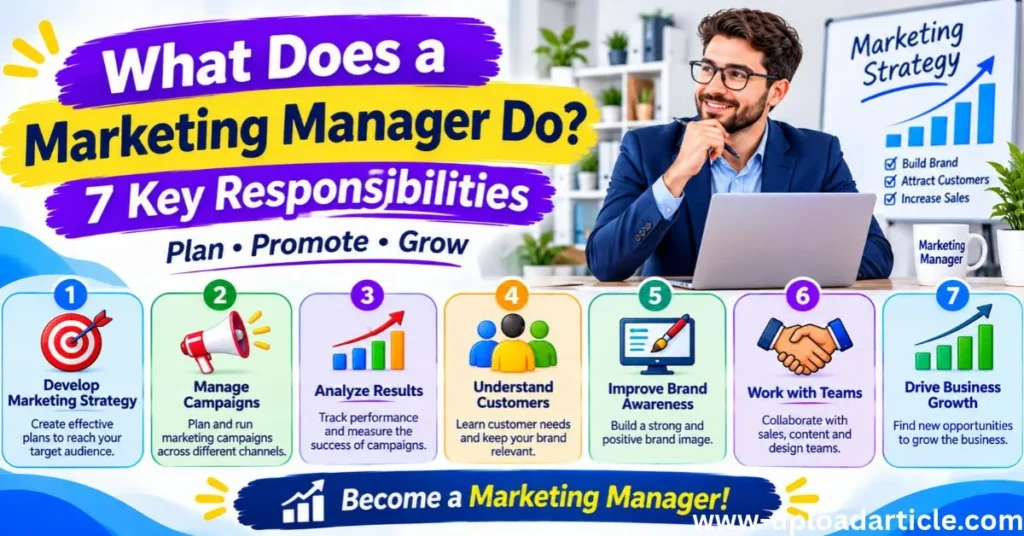
Marketing plays an important role in helping businesses attract customers, promote products, build brand awareness, and increase sales. Behind many successful marketing campaigns is a professional who plans activities, manages teams, studies customer behavior, and measures results. This professional is known as a marketing manager.
But what does a marketing manager do on a daily basis? What responsibilities does this role involve, and what skills are needed to become successful in this career?
A marketing manager is responsible for planning, organizing, and overseeing marketing activities that support a company’s business goals. Depending on the organization, the role may involve digital marketing, traditional advertising, market research, social media, content creation, budgeting, and campaign management.
In this guide, we explain the main responsibilities of a marketing manager, the skills required for the position, common tools, career opportunities, and how someone can start working toward this profession.
What Is a Marketing Manager?
A marketing manager is a professional who develops and manages strategies to promote a company’s products, services, or brand. The main goal is to connect a business with the right audience and encourage people to take valuable actions, such as making a purchase, requesting information, or becoming long-term customers.
Marketing managers work in many industries, including technology, retail, healthcare, education, finance, hospitality, and e-commerce.
Their responsibilities depend on the size and structure of the company. In a small business, one marketing manager may handle several activities personally. In a larger organization, they may supervise specialists responsible for advertising, social media, SEO, public relations, and content marketing.
What is the main goal of a marketing manager?
The central goal is to make marketing activities support business objectives.
These objectives may include:
- Increasing brand awareness.
- Attracting potential customers.
- Generating qualified leads.
- Increasing product or service sales.
- Improving customer engagement.
- Building customer loyalty.
- Entering new markets.
- Improving the return on marketing investment.
A marketing manager does not simply create advertisements. They make decisions about who the business should target, what message it should communicate, which channels it should use, and how success should be measured.
What Does a Marketing Manager Do? Seven Key Responsibilities
The responsibilities of a marketing manager can vary, but most positions include several important areas.
1. Developing Marketing Strategies
One of the most important responsibilities is creating a marketing strategy.
A marketing strategy explains how a business will reach its target audience and achieve specific marketing goals. Before planning a campaign, a manager needs to understand the company’s products, customers, competitors, budget, and market position.
For example, a company launching a new software product may want to attract small business owners. Its marketing manager could develop a strategy involving educational blog posts, search engine optimization, email campaigns, social media, and paid advertisements.
A useful marketing strategy generally includes:
- Business and marketing objectives.
- Target audience research.
- Competitor analysis.
- Brand positioning.
- Marketing channels.
- Campaign planning.
- Budget allocation.
- Performance measurements.
The strategy provides direction so that different marketing activities work toward the same objectives.
2. Managing Marketing Campaigns
Marketing managers plan and oversee campaigns designed to promote products, services, or brands.
A campaign may focus on launching a new product, promoting a seasonal offer, generating leads, or increasing website traffic.
Their work may include:
- Setting campaign objectives.
- Selecting appropriate marketing channels.
- Preparing campaign schedules.
- Coordinating designers and content writers.
- Reviewing advertising materials.
- Monitoring campaign performance.
- Adjusting campaigns when results are below expectations.
For example, an online store may run a campaign during a holiday shopping season. The marketing manager could coordinate promotional emails, social media posts, search advertisements, and website banners.
The manager monitors performance throughout the campaign and identifies which activities are producing the best results.
3. Conducting Market and Customer Research
Understanding customers is essential for successful marketing.
Marketing managers research what customers need, what problems they face, what products they prefer, and how they make purchasing decisions.
They may use:
- Customer surveys.
- Interviews and feedback.
- Website analytics.
- Competitor research.
- Industry reports.
- Social media discussions.
- Search trend information.
- Sales and customer service data.
Market research also helps businesses understand competitors. A manager may examine competitor pricing, promotional messages, product features, and customer reviews.
This information can help a company identify opportunities, improve its messaging, and create products or services that better match customer needs.
4. Managing Digital Marketing Activities
Digital marketing is an important part of many marketing manager positions.
Businesses use online channels to reach potential customers, communicate with existing audiences, and promote their products.
Depending on the company, a marketing manager may oversee:
Search Engine Optimization (SEO): Improving website visibility in organic search results through technical improvements, useful content, keyword research, and relevant links.
Social Media Marketing: Planning content and campaigns for platforms such as Facebook, Instagram, LinkedIn, and other social networks.
Content Marketing: Managing blog articles, guides, videos, infographics, and other educational resources.
Email Marketing: Planning newsletters, promotional emails, and automated communication with subscribers.
Paid Advertising: Managing or supervising paid campaigns on search engines and social media platforms.
The manager may perform some of these activities directly or work with specialized employees and external agencies.
5. Managing Marketing Budgets
Marketing activities require money, and managers must make sure that spending supports business objectives.
A marketing budget may cover advertising, software, content production, design, research, agency services, events, and other promotional activities.
Marketing managers may be responsible for:
- Preparing marketing budget proposals.
- Allocating funds across different channels.
- Monitoring campaign expenses.
- Reviewing advertising costs.
- Comparing spending with results.
- Identifying opportunities to improve efficiency.
For example, if paid advertising generates many website visitors but very few sales, the marketing manager may investigate the campaign’s audience, landing page, and conversion process before deciding whether to continue spending.
Budget management is not simply about spending less. It is about using available resources effectively.
6. Leading and Coordinating Marketing Teams
Marketing managers often work with different professionals to complete projects and campaigns.
Depending on the organization, the team may include:
- SEO specialists.
- Social media managers.
- Content writers.
- Graphic designers.
- Advertising specialists.
- Email marketing professionals.
- Web developers.
- Public relations professionals.
The marketing manager helps coordinate their work and ensures that everyone understands the campaign’s objectives, deadlines, and responsibilities.
Leadership responsibilities may include assigning tasks, reviewing work, conducting meetings, supporting team members, and communicating with other departments.
Good coordination is important because marketing campaigns often involve several people working on different parts of the same project.
7. Tracking Results and Preparing Reports
A marketing manager must understand whether marketing activities are producing the expected results.
This requires monitoring performance data and preparing reports for business owners, executives, or other departments.
Common marketing measurements include:
| Metric | What it measures |
|---|---|
| Website traffic | Visitors coming to a website |
| Conversion rate | Percentage of visitors completing a desired action |
| Click-through rate (CTR) | Percentage of people who click after seeing a link or advertisement |
| Cost per lead (CPL) | Average cost of generating a lead |
| Customer acquisition cost (CAC) | Cost of acquiring a customer |
| Return on investment (ROI) | Financial return compared with the investment |
| Engagement rate | Audience interaction with content |
For example, a marketing manager may compare two advertising campaigns to identify which one generates more qualified leads at a lower cost.
Reports help managers make informed decisions instead of relying only on assumptions.
What Does a Marketing Manager Do on a Daily Basis?
A marketing manager’s daily routine depends on the company, industry, and team size. Some days involve planning and meetings, while others focus on campaign reviews, research, and reporting.
Here is an example of what a typical working day might look like.
| Time | Possible activity |
|---|---|
| 9:00 AM | Review emails, campaign updates, and performance dashboards |
| 9:30 AM | Check marketing goals and ongoing projects |
| 10:30 AM | Attend a team meeting |
| 11:30 AM | Review content and advertising materials |
| 12:30 PM | Take a lunch break |
| 1:30 PM | Analyze customer and competitor research |
| 2:30 PM | Coordinate with designers, writers, or specialists |
| 3:30 PM | Review advertising performance and budget |
| 4:30 PM | Prepare reports and plan upcoming activities |
This schedule is only an example. A marketing manager working in a small business may spend more time creating content and managing social media. A manager in a large company may focus more on strategy, budgets, team leadership, and performance reviews.
Important Skills Every Marketing Manager Needs
Successful marketing managers need a combination of communication, analytical, creative, and leadership skills.
Communication Skills
Marketing managers communicate with employees, customers, business owners, agencies, and other departments.
They need to explain ideas clearly, present campaign plans, write professional messages, and provide useful feedback.
Analytical Skills
Marketing decisions should be supported by data.
Managers need to understand performance reports, recognize trends, compare campaign results, and identify areas that require improvement.
Leadership Skills
Managing people and projects requires organization, responsibility, and the ability to guide a team toward shared goals.
Creativity
Marketing often requires fresh ideas to attract attention and communicate a brand’s message.
Creative thinking helps managers develop campaign concepts, promotional messages, and content ideas.
Project Management
Campaigns usually involve multiple tasks and deadlines. Marketing managers need to organize work, assign responsibilities, track progress, and manage competing priorities.
Digital Marketing Knowledge
Understanding SEO, social media, paid advertising, email marketing, analytics, and content marketing can help managers make better decisions.
Problem-Solving
Marketing campaigns do not always perform as expected. A manager should be able to investigate problems, evaluate alternatives, and make practical changes.
What Education Is Required to Become a Marketing Manager?
There is no single educational path that guarantees a marketing management career.
Many employers prefer candidates with a bachelor’s degree in areas such as:
- Marketing.
- Business Administration.
- Management.
- Communications.
- Advertising.
- Public Relations.
- Economics.
Some employers may also consider candidates with relevant experience, practical skills, professional certifications, and a strong portfolio.
A degree can provide a foundation in business, consumer behavior, communication, and marketing principles. However, practical experience is also important.
Can You Become a Marketing Manager Without a Degree?
It may be possible, depending on the employer and the role.
People can build marketing skills through online courses, internships, freelance projects, personal websites, and entry-level marketing positions.
For example, someone interested in digital marketing could start by learning SEO, content creation, social media management, and analytics. They could then develop a portfolio showing real projects and measurable results.
A person without a degree may need to demonstrate stronger practical experience to compete for certain positions.
Tools Marketing Managers Commonly Use
Marketing managers use different tools to plan campaigns, understand audiences, manage projects, and measure performance.
Here are some examples:
| Tool | Common purpose |
|---|---|
| Google Analytics 4 | Understanding website traffic and user activity |
| Google Search Console | Monitoring website search performance |
| Google Ads | Managing search and other advertising campaigns |
| Meta Ads Manager | Managing Facebook and Instagram advertising |
| Mailchimp | Email marketing and audience communication |
| HubSpot | CRM, marketing automation, and campaign management |
| Canva | Creating marketing graphics and visual content |
| Trello | Organizing tasks and projects |
| Asana | Managing team projects and deadlines |
| Semrush | SEO research and competitor analysis |
Not every marketing manager uses all these tools. The choice depends on the company’s needs, budget, marketing channels, and existing systems.
Types of Marketing Managers
Marketing is a broad profession, so some managers specialize in particular areas.
Digital Marketing Manager
A digital marketing manager oversees online marketing activities such as SEO, paid advertising, social media, email campaigns, and website marketing.
Brand Marketing Manager
A brand marketing manager focuses on brand identity, positioning, messaging, and customer perception.
Product Marketing Manager
A product marketing manager helps position products in the market, understand customer needs, develop product messaging, and support product launches.
Social Media Marketing Manager
A social media marketing manager plans and manages social media content, campaigns, audience engagement, and platform performance.
Content Marketing Manager
A content marketing manager oversees the planning, creation, publication, and measurement of content such as articles, guides, videos, and newsletters.
Marketing Communications Manager
A marketing communications manager coordinates promotional messages and communication across channels, helping maintain a consistent brand voice.
Although these positions share some responsibilities, their daily tasks and areas of expertise can be quite different.
How Much Does a Marketing Manager Earn?
A marketing manager’s salary depends on several factors, including:
- Country and city.
- Industry.
- Years of experience.
- Company size.
- Education and qualifications.
- Team and budget responsibilities.
- Specialized marketing skills.
For example, a marketing manager in a large technology company may have different compensation from someone managing marketing for a small local business.
Digital marketing, product marketing, analytics, and marketing automation experience may also influence job opportunities and compensation.
Marketing Manager Salary in the United States
People researching US marketing manager salaries should use current salary information rather than relying on an old fixed figure.
The US Bureau of Labor Statistics publishes occupational employment and wage information for advertising, promotions, and marketing managers. Its figures provide a useful starting point for understanding the profession.
Salary data can be reviewed through the official Bureau of Labor Statistics website.
Remember that national median wages are not guaranteed salaries. Actual compensation depends on the position, location, experience, and employer.
Marketing Manager vs. Marketing Specialist: What Is the Difference?
A marketing manager and a marketing specialist both contribute to business promotion, but their responsibilities are usually different.
| Area | Marketing Manager | Marketing Specialist |
|---|---|---|
| Main focus | Strategy and overall coordination | A particular marketing activity |
| Planning | Develops broader marketing plans | Supports specific campaigns |
| Team responsibilities | May lead a marketing team | Usually focuses on assigned work |
| Budget | May manage or approve budgets | May monitor assigned campaign spending |
| Reporting | Reviews overall performance | Reports on specialized activities |
| Decision-making | Often makes strategic decisions | Makes decisions within an assigned area |
For example, an SEO specialist may focus on keyword research, technical SEO, and content optimization. A marketing manager may oversee SEO as one part of a wider strategy that also includes advertising, email, social media, and brand development.
The exact distinction depends on the company’s organizational structure.
How to Become a Marketing Manager: A Step-by-Step Guide
If you want to pursue a career in marketing management, you can develop your skills gradually.
Step 1: Learn Marketing Fundamentals
Start by understanding target audiences, customer behavior, branding, market research, advertising, and marketing strategies.
Step 2: Learn Digital Marketing
Develop knowledge of SEO, social media, content marketing, email marketing, paid advertising, and analytics.
Step 3: Practice With Real Projects
Create a small website, manage a social media page, develop a content plan, or run a sample marketing campaign.
Practical projects can help you understand how marketing concepts work outside a classroom.
Step 4: Build a Portfolio
Collect examples of your work, such as:
- Marketing plans.
- SEO reports.
- Social media campaigns.
- Content calendars.
- Advertising examples.
- Website performance improvements.
Explain your role and the results honestly. Never present sample projects as paid client work if they were not.
Step 5: Gain Work Experience
Consider internships, freelance projects, or entry-level roles such as marketing assistant, social media coordinator, SEO specialist, or marketing executive.
These positions can help you understand business operations and develop practical experience.
Step 6: Improve Leadership and Analytical Skills
Learn how to manage projects, coordinate with colleagues, interpret marketing data, and communicate recommendations.
Step 7: Apply for Management Opportunities
Once you have developed relevant experience, practical skills, and a portfolio, you can apply for marketing manager positions that match your background.
Is Marketing Management a Good Career in 2026?
Marketing management can be a rewarding career for people who enjoy business strategy, communication, creativity, research, and problem-solving.
Businesses across many industries need ways to reach customers and explain the value of their products or services. This creates opportunities for professionals with marketing knowledge and practical experience.
The profession is also changing as companies adopt artificial intelligence, automation, customer analytics, and new digital platforms.
Marketing managers increasingly need to understand how to use technology while maintaining human judgment, accurate communication, and customer trust.
Advantages of a Marketing Management Career
- Opportunities in different industries.
- A combination of creative and analytical work.
- Potential to progress into senior leadership roles.
- Opportunities to work with international clients.
- Possibility of freelance or consulting work.
- Exposure to new technologies and marketing methods.
Challenges of the Profession
- Marketing trends and platforms change frequently.
- Campaign results can be unpredictable.
- Managers may work under demanding deadlines.
- Budget limitations can affect campaign performance.
- Managing multiple people and projects can be challenging.
- Marketing performance is often measured against business targets.
A successful career requires continuous learning and the ability to adapt to changing customer expectations.
Conclusion
A marketing manager plays an important role in connecting businesses with their target audiences. The job involves much more than advertising products. It includes developing strategies, managing campaigns, researching customers, overseeing budgets, coordinating teams, and measuring performance.
The exact responsibilities depend on the company’s size, industry, and marketing goals. Some managers focus on digital marketing, while others handle broader brand and business strategies.
For anyone interested in this career, the best starting point is to learn marketing fundamentals, develop digital skills, gain practical experience, and build a portfolio of real or clearly labeled sample projects.
With continuous learning and the right experience, marketing management can offer opportunities across a wide range of industries.
FAQs
What does a marketing manager do in simple words?
A marketing manager plans and manages activities that help a business promote its products or services, attract customers, build brand awareness, and increase sales.
What are the five main responsibilities of a marketing manager?
Five common responsibilities are developing marketing strategies, managing campaigns, researching customers and competitors, overseeing marketing budgets, and measuring campaign performance.
What does a marketing manager do every day?
Daily tasks may include reviewing campaign results, attending meetings, coordinating team members, checking marketing content, researching competitors, managing budgets, and preparing reports.
Do marketing managers need a degree?
Many employers prefer a bachelor’s degree in marketing, business, communications, or a related field. However, some employers may consider relevant experience, practical skills, certifications, and a strong portfolio.
Is marketing management difficult?
It can be challenging because managers must balance strategy, creativity, budgets, deadlines, team coordination, and performance targets. The difficulty depends on the organization and the manager’s experience.
What skills are most important for a marketing manager?
Important skills include communication, leadership, analytical thinking, creativity, project management, problem-solving, and knowledge of digital marketing.
Can a marketing manager work remotely?
Yes. Many marketing management responsibilities can be performed remotely, particularly in digital marketing teams. However, some positions require office attendance, client meetings, or travel.