
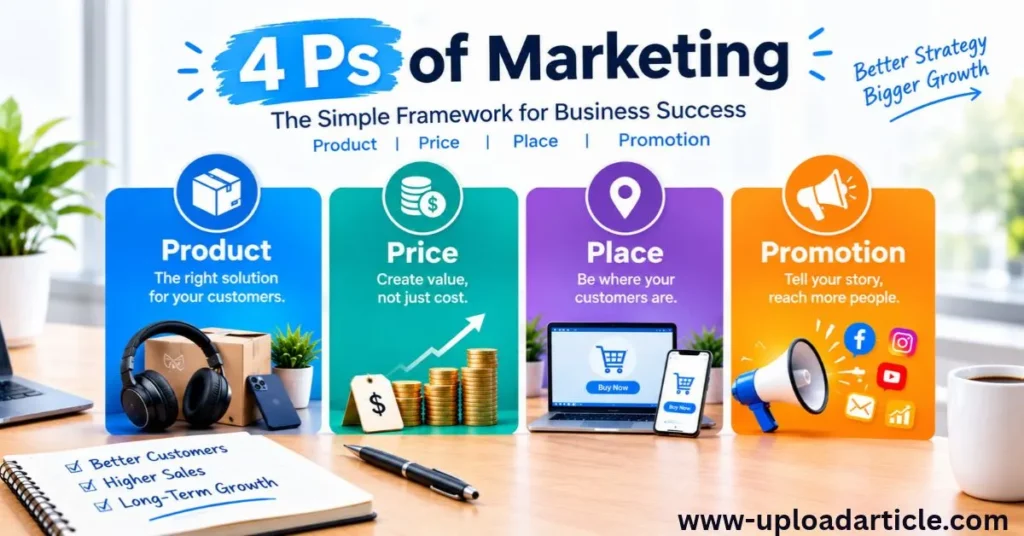
The 4 Ps of marketing are Product, Price, Place, and Promotion. These four elements form a foundational marketing framework that helps businesses develop strategies for reaching their target audiences, communicating value, and competing effectively in the marketplace. Whether a company sells physical products, digital services, software subscriptions, or professional consulting, understanding the marketing mix can help it make more informed decisions about how to position its offerings and attract customers.
Marketing is not simply about advertising a product or convincing people to make a purchase. Successful marketing involves understanding customer needs, developing an appropriate solution, setting a competitive price, choosing convenient distribution channels, and communicating the product’s benefits effectively. The 4 Ps bring these decisions together into one organized framework, allowing businesses to evaluate whether their overall marketing strategy supports their objectives and meets customer expectations.
For example, a company selling premium skincare products must consider more than the quality of its formulas. It also needs attractive packaging, a suitable pricing strategy, convenient purchasing options, and promotional campaigns that communicate the product’s benefits to the right audience. If any of these elements conflicts with the others, the company may struggle to build trust or generate consistent sales.
The 4 Ps of marketing remain relevant in modern business because they provide a practical starting point for strategic planning. Although digital platforms, artificial intelligence, social media, and online shopping have transformed customer behavior, businesses still need the right product, an appropriate price, accessible distribution, and effective promotion. Understanding these four elements can help entrepreneurs, marketers, students, and established companies build a stronger marketing strategy.
What Are the 4 Ps of Marketing?
The 4 Ps of marketing represent four interconnected decisions that influence how a business presents its products or services to customers. They are commonly known as the marketing mix because they combine different marketing activities into a coordinated plan. Instead of treating product development, pricing, distribution, and advertising as separate responsibilities, this framework encourages businesses to consider how these decisions work together.
Product refers to the solution a business offers to meet customer needs. Price represents the amount customers pay and the value they believe they receive in return. Place concerns how customers find, access, and purchase the offering. Promotion includes the communication and marketing activities used to inform potential customers, explain benefits, and encourage action.
These elements should support a consistent market position. A luxury product, for instance, may require premium packaging, selective distribution, higher pricing, and sophisticated promotional campaigns. A budget-friendly product may need affordable pricing, widespread availability, simple packaging, and promotional messages focused on practicality and value.
The framework also helps businesses identify weaknesses in their marketing strategies. A company may have an excellent product but struggle because its price is too high for its intended audience. Another business may offer competitive prices but lose customers because its products are difficult to purchase. By examining each of the 4 Ps, marketers can identify these problems and make improvements based on customer needs and business goals.
The First P: Product
Product is the first element of the marketing mix and refers to the goods, services, or solutions a business provides to customers. It includes more than the physical item itself. Features, quality, design, packaging, reliability, customer support, branding, warranties, and the overall customer experience can all influence how customers evaluate an offering.
The central purpose of a product strategy is to deliver meaningful value. Businesses need to understand the problems their customers experience, the results they want to achieve, and the reasons they might choose one solution over another. Product decisions should therefore be based on customer research, market demand, competitor analysis, and the company’s ability to deliver a reliable experience.
Consider a business that sells wireless headphones. Customers may care about sound quality, battery life, comfort, durability, noise cancellation, and compatibility with their devices. If research reveals that the target audience values long battery life and comfortable design more than advanced features, the business can prioritize those benefits in product development and marketing communications.
Product decisions also change throughout the product life cycle. A newly launched product may require customer education, testing, and improvements based on early feedback. An established product may benefit from feature updates, improved packaging, or stronger differentiation. A declining product may require repositioning, a redesigned version, or a decision to discontinue it.
Important Elements of Product Strategy
A successful product strategy begins with a clear understanding of the intended customer. Businesses should identify the target audience, its needs, purchasing habits, common problems, and expectations before deciding which features to develop. This research helps companies avoid spending resources on features that customers do not value.
Quality and reliability are equally important because customers often judge a brand by their experience after purchasing. A product that performs inconsistently may generate complaints, negative reviews, returns, and reduced repeat purchases. Companies should therefore consider product testing, quality control, customer service, and continuous improvement as part of their overall product strategy.
Branding and packaging can also influence purchasing decisions. A recognizable brand helps customers identify an offering, while thoughtful packaging can communicate quality, convenience, sustainability, or a particular market position. For digital products, the equivalent experience may include website design, user interface, onboarding, documentation, and technical support.
Businesses should also consider differentiation. If competing products provide similar basic features, a company needs to explain why its offering deserves attention. Differentiation might come from better usability, specialized features, stronger customer service, a more convenient experience, or a clearer focus on a particular audience.
Product Example in the Real World
Imagine a company launching an online project management application for small businesses. Its product strategy might focus on task organization, team collaboration, deadline tracking, and easy-to-understand reporting. Instead of trying to compete with every advanced enterprise platform, the company could differentiate itself through simplicity and affordability.
The company would need to validate whether its intended customers actually value those benefits. Interviews, product demonstrations, trial usage, and customer feedback could reveal which features deserve priority. Based on the findings, the business might improve its onboarding process, simplify its dashboard, or introduce integrations that customers frequently request.
The same principles apply to content websites and online services. A website’s product experience includes the usefulness of its content, navigation, page speed, accessibility, and the value of any tools it provides. If visitors cannot find the information they need or use a tool successfully, promotional efforts alone are unlikely to create lasting satisfaction.
The Second P: Price
Price is the second element of the 4 Ps of marketing and refers to what customers pay to obtain a product or service. Pricing directly affects revenue, profit margins, market positioning, customer expectations, and perceived value. It can also influence whether customers consider a product affordable, premium, economical, or worth comparing with competing alternatives.
Setting the right price requires more than adding a profit margin to production costs. Businesses should consider customer willingness to pay, competitor pricing, operating expenses, product differentiation, demand, and their overall business objectives. A price that is too low may reduce profitability or make customers question quality, while an excessively high price may discourage purchases if the offering does not provide enough perceived value.
For example, a company selling a productivity application might offer a free plan with basic features, a paid monthly plan for individuals, and a higher-priced subscription for teams. This structure allows customers to choose a plan that matches their needs and budget while giving the business opportunities to generate recurring revenue.
Pricing should also reflect the intended market position. A premium brand may charge more because it offers specialized features, superior service, exclusive design, or a carefully developed customer experience. A value-focused brand may prioritize affordability and efficiency. Neither approach is automatically better; the appropriate choice depends on the target market and the value customers recognize.
Common Pricing Strategies
Cost-based pricing involves calculating the costs associated with producing and delivering an offering, then adding a margin to establish the selling price. This approach can help businesses understand their minimum financial requirements, but it may overlook how customers value the product or how competitors price similar offerings.
Value-based pricing focuses on the benefits customers believe they receive. For example, a business software provider may charge more for a tool that saves employees substantial time, reduces errors, or simplifies an expensive process. The price depends partly on the value delivered rather than only on the cost of developing the software.
Competition-based pricing considers the prices of similar offerings in the marketplace. A company may price close to competitors, charge less to attract cost-conscious customers, or charge more when it can demonstrate meaningful advantages. However, simply copying competitors’ prices can be risky because their operating costs, customer segments, and business models may be different.
Penetration pricing involves introducing a product at a relatively low price to attract customers and establish market presence. Skimming pricing takes the opposite approach by launching at a higher price to target customers willing to pay more before potentially adjusting prices later. Both strategies require careful planning, and their suitability depends on competition, demand, product differentiation, and long-term profitability.
Subscription pricing is common for software, digital services, memberships, and other offerings that provide ongoing value. Businesses may offer monthly or annual plans, different feature tiers, or usage-based charges. Clear pricing information and transparent billing terms are essential for maintaining customer trust.
Price Example for a Digital Marketing Service
Suppose a digital marketing agency offers search engine optimization services to small businesses. Its pricing may depend on the scope of work, website size, competition, technical complexity, content requirements, and reporting needs. A basic package might focus on an SEO audit and on-page improvements, while a larger engagement could include technical SEO, content planning, and ongoing performance analysis.
The agency should explain what each package includes instead of competing solely on the lowest price. Customers need to understand the expected deliverables, reporting schedule, limitations, and the difference between one-time work and ongoing services. This clarity makes comparisons easier and helps reduce misunderstandings.
The agency should also avoid guaranteeing specific search rankings simply to justify a higher price. Search performance depends on multiple factors, including competition, website quality, search engine changes, and customer demand. A transparent pricing strategy should describe the work being performed and the measurable outcomes being monitored without promising results that cannot be controlled.
The Third P: Place
Place is the third element of the marketing mix and refers to how a product or service reaches customers. It includes distribution channels, sales locations, delivery methods, online marketplaces, retail partners, inventory management, and the convenience of the purchasing process. The objective is to make the offering available where and when the intended audience wants to buy it.
Place is especially important because customers may prefer different ways of discovering and purchasing products. Some prefer visiting a physical store to inspect an item before buying. Others want to order through a website, use a mobile application, or purchase from an established online marketplace. Businesses must understand these preferences and choose distribution channels that fit their customers and resources.
For example, a clothing brand might sell through its own ecommerce website, selected retail stores, and online marketplaces. Each channel offers different advantages. A direct website gives the brand greater control over the customer experience and customer relationships, while retail partnerships may provide access to audiences the company would otherwise struggle to reach.
Place also includes operational decisions that customers may not see directly. Delivery speed, product availability, returns, inventory accuracy, payment options, and order tracking all affect convenience. Even an attractive product with competitive pricing can lose sales if customers cannot obtain it easily or receive unreliable service.
Distribution Channels and Their Importance
Direct distribution occurs when a business sells directly to customers without relying on an independent reseller. Examples include a company’s ecommerce website, its own physical store, or a sales team handling orders. Direct distribution can provide greater control over pricing, branding, customer communication, and first-party customer data, subject to applicable privacy requirements.
Indirect distribution involves intermediaries such as wholesalers, distributors, retailers, agents, or marketplaces. These partners can help businesses expand their reach, access established customer networks, and reduce the need to build every part of the sales operation themselves. However, indirect channels may involve additional costs, less control over the presentation of products, or restrictions on customer relationships.
Multichannel distribution uses more than one sales channel. A company might operate a physical shop, maintain an ecommerce website, and sell through marketplaces. Omnichannel marketing goes further by attempting to connect these channels so customers receive a more consistent experience as they move between them.
For example, customers might research a product online, inspect it in a store, and later purchase it through a mobile application. A coordinated system can help provide consistent product information, pricing, availability, and customer support across these interactions.
Place in Digital Marketing
For digital businesses, place is not limited to geographical locations. It also involves choosing the online platforms and environments where customers can discover and access an offering. These may include company websites, search engines, social media platforms, app stores, online directories, marketplaces, and email-based purchasing journeys.
A content website, for example, needs to make its articles accessible through clear navigation, category pages, internal links, mobile-friendly layouts, and useful search functionality. Search engine optimization can help relevant pages become discoverable in organic search results, while a well-organized website helps visitors find related information once they arrive.
A software company may distribute its product through a dedicated website, an application marketplace, or partnerships with other technology providers. A service business may use its website to explain its services, collect inquiries, schedule consultations, and provide customer support. The appropriate approach depends on where the target audience prefers to search and take action.
Businesses should evaluate distribution channels according to customer reach, operating costs, conversion rates, reliability, and the quality of the experience they create. A channel that generates substantial traffic but attracts the wrong audience may be less valuable than one that produces fewer but more relevant visitors.
The Fourth P: Promotion
Promotion is the fourth element of the 4 Ps of marketing. It includes the communication activities businesses use to inform potential customers, explain product benefits, build brand awareness, generate interest, and encourage purchasing decisions. Promotion can involve advertising, public relations, sales promotions, content marketing, email campaigns, social media, influencer partnerships, and personal selling.
The purpose of promotion is not simply to make a product visible. Effective promotional activities communicate the right message to the right audience through suitable channels. A campaign should explain why the offering matters, how it solves a problem, and what makes it relevant compared with available alternatives.
For example, a company selling environmentally conscious household products might publish educational articles about waste reduction, create short social media demonstrations, collaborate with relevant creators, and run targeted advertisements. Each activity could communicate a different aspect of the product’s value while supporting a consistent brand message.
Promotional strategies should be connected to measurable objectives. A campaign intended to introduce a new brand may focus on awareness and reach. A campaign designed to generate sales may prioritize qualified website visits, product demonstrations, inquiries, or completed purchases. Clear objectives make it easier to determine whether promotional spending is producing meaningful results.
Major Types of Promotion
Advertising includes paid communications delivered through channels such as search engines, social networks, websites, television, radio, and print publications. Digital advertising allows businesses to target audiences using available platform settings and evaluate performance through impressions, clicks, conversions, and other metrics. Results still depend on the quality of the offer, creative material, targeting, and landing page experience.
Content marketing involves creating and distributing useful information that attracts and supports a relevant audience. Articles, tutorials, guides, videos, case studies, and educational resources can help businesses answer questions and demonstrate expertise. Content marketing is particularly useful when customers need information before making a purchasing decision.
Search engine optimization helps improve a website’s ability to appear in relevant organic search results. It involves understanding search intent, creating helpful content, improving technical accessibility, organizing information, and developing a trustworthy website. Unlike paid advertising, organic visibility is not purchased through a direct payment for each placement, and rankings cannot be guaranteed.
Social media marketing helps businesses communicate with audiences through platforms where they spend time discovering information, following brands, and discussing products. Depending on the audience, a company may use educational posts, demonstrations, short videos, community discussions, or paid campaigns to build awareness and encourage engagement.
Email marketing allows businesses to communicate with people who have chosen to receive their messages. Newsletters, onboarding emails, product updates, and promotional campaigns can support customer relationships and repeat purchases. Businesses should respect consent requirements, provide clear unsubscribe options where required, and avoid sending unsolicited messages.
Public relations focuses on managing relationships with media organizations, industry stakeholders, communities, and other relevant audiences. Activities may include press announcements, expert commentary, interviews, partnerships, and reputation management. Sales promotions, such as limited-time discounts or bundled offers, can encourage short-term action but should be planned carefully to avoid weakening perceived value.
Promotion Example for a Small Business
Imagine a local bakery introducing a new range of customized celebration cakes. Its promotional strategy could begin with professional product photography, a website gallery, and useful pages explaining customization options. The bakery might then share cake designs on social media, encourage satisfied customers to leave honest reviews, and use local search optimization to help nearby customers discover its services.
The business could also create seasonal campaigns for birthdays, weddings, graduations, and other occasions. Email updates may help previous customers discover new designs, provided they have agreed to receive those communications. Small paid advertising campaigns could target relevant locations and customer interests where platform policies and targeting options permit.
To evaluate results, the bakery should track inquiries, orders, average order value, customer acquisition cost, and repeat purchases. Likes and views may indicate interest, but they do not automatically demonstrate profitability. By measuring meaningful outcomes, the business can focus its promotional budget on the activities that contribute most effectively to its goals.
Why the 4 Ps of Marketing Are Important
The 4 Ps of marketing provide a structured way to connect customer needs with business decisions. Without a coordinated framework, companies may develop products that do not match demand, choose prices that weaken profitability, distribute products through inconvenient channels, or spend promotional budgets on audiences unlikely to purchase.
One major advantage of the framework is strategic consistency. Product features, pricing, distribution, and promotional messages should reinforce the same market position. When these elements work together, customers receive a clearer explanation of what the business offers and why it may be worth choosing.
The framework also supports better resource allocation. Businesses generally operate with limited budgets, staff, and time. Reviewing the marketing mix can help managers identify which decisions require improvement and prioritize activities based on customer value, commercial potential, and available resources.
Another benefit is improved customer understanding. Each element encourages a different but connected question: What do customers need? What are they willing to pay? Where do they prefer to purchase? What information helps them make a decision? Answering these questions can improve the customer experience and reduce avoidable marketing mistakes.
The 4 Ps can also help businesses respond to changing market conditions. Customer expectations, technologies, competitors, and distribution channels evolve over time. Reviewing the marketing mix regularly allows companies to adjust their offers, prices, channels, and promotional activities when evidence suggests that a change is necessary.
Real-World Example of the 4 Ps of Marketing
Consider a fictional brand called GreenCup that sells reusable travel cups to environmentally conscious consumers. The company wants to differentiate itself from inexpensive disposable alternatives and establish a recognizable position in the reusable drinkware market. Applying the 4 Ps helps GreenCup organize its strategy around customer needs and a consistent value proposition.
Product: GreenCup develops reusable cups with durable materials, practical lids, easy cleaning, and attractive designs. It researches customer preferences to understand which sizes, colors, and features matter most. Product information explains the materials, care instructions, and intended use so customers can make informed decisions.
Price: The company selects a price that reflects production costs, distribution expenses, competitive alternatives, and the value customers associate with durability and convenience. It may offer multipacks or a loyalty incentive while ensuring that discounts do not undermine its financial objectives. The price communicates the brand’s position without relying on unsupported environmental claims.
Place: GreenCup sells through its own ecommerce website and selected retail partners. Its website provides clear product descriptions, shipping details, stock information, and a straightforward checkout process. Retail distribution allows customers to see the product in person, while online sales provide convenience for customers who prefer home delivery.
Promotion: The company publishes product demonstrations, care guides, and educational content about reusable drink ware. It may collaborate with relevant creators, run targeted digital advertising, and encourage customers to share genuine experiences. Promotional messages focus on verifiable product benefits rather than making exaggerated claims about environmental impact.
The example demonstrates why the 4 Ps should not be planned independently. Product quality supports the price, distribution makes the product accessible, and promotion explains the benefits to potential customers. If Green Cup changes its target audience or introduces a premium product line, it may need to reconsider all four elements to maintain a consistent strategy.
How to Develop an Effective Marketing Mix
Developing an effective marketing mix starts with research rather than assumptions. Businesses should examine their target customers, competitors, industry conditions, and commercial objectives before making decisions about the 4 Ps. Research does not eliminate uncertainty, but it provides a stronger foundation for choosing which strategies to test.
The first step is to define the target audience. A business should understand the people or organizations it wants to serve, including their needs, purchasing motivations, budget constraints, and preferred communication channels. Customer interviews, surveys, sales records, website analytics, and competitor reviews can provide useful insights when interpreted carefully.
The second step is to clarify the product’s value proposition. Businesses need to explain what problem their offering solves, who benefits from it, and how it differs from alternatives. A clear value proposition helps guide product development, pricing, distribution, and promotional messaging.
The third step is to establish pricing that supports customer value and business sustainability. Managers should evaluate costs, demand, competitor offerings, margins, and customers’ willingness to pay. Different pricing models can be tested where appropriate, but the business should monitor their effect on revenue, profitability, retention, and customer perception.
The fourth step is to select distribution channels that match customer behaviour and operational capacity. Companies should consider where customers search for products, how they prefer to purchase, and what level of convenience they expect. A channel should be assessed not only by its reach but also by its costs, reliability, and ability to produce suitable customer experiences.
The fifth step is to create a promotional plan with clear objectives. Businesses should choose appropriate messages, content formats, channels, budgets, and performance indicators. Awareness campaigns, lead-generation activities, and sales campaigns require different approaches, so the promotional plan should reflect the intended outcome.
Finally, businesses should measure performance and improve the marketing mix over time. Sales, conversion rates, customer feedback, profit margins, repeat purchases, and customer acquisition costs can reveal whether the current approach is effective. Decisions should be based on relevant evidence rather than changing every element simply because a campaign has not produced immediate results.
The 4 Ps of Marketing in Digital Marketing
Digital marketing has created new ways to apply the traditional marketing mix, but it has not removed the importance of its four elements. Online businesses still need valuable offerings, appropriate prices, convenient access, and persuasive communication. Digital channels simply provide additional methods for researching customers, delivering products, and measuring marketing performance.
Product decisions in digital marketing include website usability, mobile compatibility, digital content quality, application functionality, online customer support, and the overall experience of using a service. A company selling an online course, for example, must consider lesson quality, navigation, accessibility, learner support, and how effectively the course meets students’ needs.
Price decisions may include free trials, subscription plans, tiered packages, introductory offers, and usage-based pricing. Digital businesses can test different packages and monitor how pricing affects conversion rates, revenue, cancellations, and customer satisfaction. These tests should be designed carefully so results reflect genuine customer behaviour rather than temporary or misleading fluctuations.
Place in digital marketing concerns where and how customers discover and access an offering. A business might rely on its website, search engines, mobile applications, social platforms, marketplaces, or partner websites. Search engine optimization, clear website navigation, accessible landing pages, and convenient payment processes can help make the offering easier to discover and use.
Promotion includes SEO, paid search advertising, content marketing, social media campaigns, email marketing, affiliate partnerships, and other communication activities. The most suitable combination depends on the target audience, budget, competitive environment, and customer journey. Businesses should connect promotional activities with clear goals and monitor results using reliable analytics.
For example, a company offering online graphic design services might create easy-to-use service packages, set transparent prices, sell through its website, and publish tutorials that demonstrate its expertise. It could then use organic search, social media, and email communications to reach relevant audiences. When all four Ps reinforce one another, the company has a more coherent approach to attracting and serving customers.
The 4 Ps of Marketing and Search Engine Optimization
Search engine optimization can support the marketing mix by helping businesses understand customer questions, improve website accessibility, and connect useful content with relevant search intent. SEO is not a replacement for product, price, place, or promotion. Instead, it can strengthen different parts of the marketing strategy when applied appropriately.
Product-related SEO begins with understanding what customers want to accomplish. Search queries, customer feedback, support questions, and competitor content can reveal unmet needs and information gaps. Businesses can use these insights to improve their products, service descriptions, documentation, and educational resources.
Price-related content can help customers understand available options before making a decision. Transparent pricing pages, plan comparisons, service descriptions, and explanations of included features may attract people researching costs. Such pages should provide accurate information and avoid misleading claims or artificial price comparisons.
Place-related SEO includes creating logical website architecture, improving internal navigation, ensuring important pages can be crawled, and providing a good mobile experience. Local businesses may also benefit from accurate business information and relevant local pages. These improvements can make it easier for search engines and users to understand and access the website’s content.
Promotion-related SEO involves publishing useful, relevant content that addresses real audience needs. Keyword research helps identify the language people use when searching, while search intent analysis helps determine the information a page should provide. Internal links can connect related articles and service pages, making it easier for readers to explore a subject in greater depth.
For a digital marketing website such as UploadArticle.com, an article about the 4 Ps of marketing could connect naturally with future guides on digital marketing strategy, SEO fundamentals, content marketing, market research, and customer acquisition. Each internal link should lead to a genuinely relevant page and help readers continue their learning journey. The goal should be useful navigation and comprehensive topic coverage, not simply inserting keywords wherever possible.
Difference Between the 4 Ps and the 7 Ps of Marketing
The 4 Ps of marketing provide a foundational framework that is particularly useful for understanding products, pricing, distribution, and promotion. However, businesses that provide services often need to consider additional factors because the customer experience depends heavily on people, processes, and the service environment.
The 7 Ps extend the traditional framework by adding People, Process, and Physical Evidence. These additional elements help businesses evaluate how services are delivered, how employees interact with customers, and what tangible signals customers use to judge service quality.
People refers to employees, service providers, sales representatives, and other individuals who influence the customer experience. In a consulting firm, knowledgeable staff and responsive communication can significantly affect customer satisfaction and retention.
Process covers the procedures and systems through which a service is delivered. Examples include booking appointments, processing payments, responding to inquiries, handling complaints, and delivering completed work. Clear processes can improve reliability and reduce customer frustration.
Physical Evidence refers to the tangible or observable signals that help customers evaluate a service. These may include office design, branded materials, professional reports, website quality, testimonials, and the appearance of a digital platform. For online services, the website interface and quality of documentation may provide important evidence of professionalism.
The 7 Ps are especially useful for service-based businesses such as marketing agencies, hotels, educational institutions, healthcare providers, and consulting firms. Nevertheless, the original 4 Ps remain valuable because they provide the basic structure on which a broader service marketing strategy can be developed.
Difference Between the 4 Ps and the 4 Cs of Marketing
The 4 Cs of marketing provide a customer-oriented perspective that complements the traditional 4 Ps. While the 4 Ps are commonly presented from the business’s planning perspective, the 4 Cs encourage marketers to examine the same strategic decisions in terms of customer needs and experiences.
The four Cs are Customer Value, Cost, Convenience, and Communication. Customer Value focuses on the problem a product solves rather than simply the features it contains. Cost considers the customer’s overall expense, which may include money, time, effort, and perceived risk. Convenience examines how easily the customer can obtain and use the offering. Communication emphasizes two-way interaction rather than treating promotion as a one-directional message.
For example, a business planning a new online learning platform might use the 4 Ps to define course features, subscription pricing, website distribution, and promotional campaigns. Using the 4 Cs would encourage it to ask whether the courses address learners’ actual needs, whether the total cost is acceptable, whether enrollment is convenient, and whether students can receive useful support.
The two frameworks do not need to compete. Businesses can use the 4 Ps to organize marketing decisions and the 4 Cs to check whether those decisions genuinely serve the intended audience. Combining the perspectives can help companies avoid focusing too heavily on internal objectives while overlooking customer expectations.
Common Mistakes When Applying the 4 Ps of Marketing
One common mistake is developing a product without sufficient customer research. Businesses sometimes assume that their ideas will automatically appeal to buyers, only to discover that the market values different features or has different priorities. Research, testing, and feedback can reduce this risk and help guide product improvements.
Another mistake is setting prices based exclusively on competitors. Competitor prices provide useful context, but they do not reveal the full picture of another company’s costs, margins, customer relationships, or strategic goals. A business should establish pricing that reflects its own financial requirements and the value it delivers to its intended audience.
Choosing distribution channels based only on popularity can also create problems. A platform may have a large audience but generate little meaningful business for a particular product. Companies should evaluate whether a channel reaches relevant customers, supports a suitable purchasing experience, and provides acceptable returns relative to its cost.
Some businesses also rely on promotion before fixing weaknesses in their product or customer experience. Increasing advertising expenditure cannot reliably compensate for poor quality, confusing pricing, limited availability, or an unreliable checkout process. Marketing performance often improves when the underlying offer and purchasing journey are addressed first.
A final mistake is failing to measure results. Without appropriate performance indicators, businesses may continue investing in ineffective campaigns or overlook opportunities to improve. Regular reviews of sales, customer feedback, conversion rates, margins, and retention can help managers make more informed decisions about the marketing mix.
How to Measure the Success of the 4 Ps
Measuring the marketing mix requires indicators that reflect the objectives of each element. No single metric can fully describe marketing performance, so businesses should select a balanced set of measurements and interpret them in context.
For Product, useful indicators may include customer satisfaction, product returns, feature adoption, product defect rates, customer feedback, and repeat purchase rates. The appropriate metrics depend on the product and the business model. A software company, for instance, may examine activation and retention, while a retailer may focus more heavily on returns and repeat sales.
For Price, businesses can monitor revenue, gross margin, average order value, conversion rates, discount usage, and customer retention. These measures help reveal whether a pricing strategy supports both customer demand and financial sustainability. Higher sales volume does not necessarily mean a strategy is successful if profit margins become unsustainable.
For Place, relevant indicators include distribution costs, product availability, delivery times, checkout completion rates, stockouts, and sales by channel. Businesses selling online may also assess mobile checkout performance and the percentage of customers who complete a purchase after visiting a product page.
For Promotion, useful measurements include qualified traffic, lead quality, conversion rate, customer acquisition cost, return on advertising spend, and campaign-attributed revenue. Brand awareness and engagement metrics may also matter when the objective is to introduce a new offering or build long-term recognition. However, engagement should not automatically be treated as proof of sales impact.
Businesses should establish a baseline, set realistic targets, and review results at appropriate intervals. They should also account for external influences such as seasonality, competitor activity, economic conditions, and changes in customer demand. A structured measurement process makes it easier to determine which elements are working and where improvements are needed.
Conclusion
The 4 Ps of marketing provide a practical framework for understanding how businesses create value, determine pricing, reach customers, and communicate their offerings. Product, Price, Place, and Promotion are closely connected decisions, and each can influence the effectiveness of the others. A business with a valuable product still needs an appropriate price, convenient distribution, and communication that helps the intended audience understand its benefits.
The framework remains useful for small businesses, large organizations, E-commerce stores, professional service providers, and digital marketing companies. Modern technologies have expanded the channels available to marketers, but the underlying questions remain relevant: What does the customer need? What value does the offering provide? How can the customer obtain it? What information will help the customer make an informed decision?
Businesses should treat the 4 Ps as a flexible planning framework rather than a fixed formula that guarantees success. Customer research, competitive analysis, clear objectives, and ongoing measurement are essential for adapting the marketing mix to changing circumstances. By regularly reviewing all four elements and making evidence-based improvements, businesses can build more coherent strategies and create better customer experiences.
Ultimately, effective marketing is about aligning what a business offers with what its customers value. The 4 Ps provide a clear starting point for making that alignment more deliberate, measurable, and sustainable.
FAQs
What are the 4 Ps of marketing?
The 4 Ps are Product, Price, Place, and Promotion. They help businesses develop an effective marketing strategy.
Why are the 4 Ps important?
They help businesses meet customer needs, set suitable prices, reach target audiences, and promote their offerings effectively.
What is an example of the 4 Ps?
A clothing brand develops quality products, sets competitive prices, sells online and in stores, and promotes its products through social media.
Who developed the 4 Ps of marketing?
E. Jerome McCarthy popularized the framework in his 1960 book, Basic Marketing: A Managerial Approach.
What is the difference between the 4 Ps and 7 Ps?
The 7 Ps add People, Process, and Physical Evidence to the original four elements, making the framework particularly useful for service businesses.
Are the 4 Ps still relevant today?
Yes. Businesses still need valuable products, appropriate pricing, convenient distribution, and effective promotion across digital and traditional channels.
What is the difference between the 4 Ps and 4 Cs?
The 4 Ps focus on Product, Price, Place, and Promotion, while the 4 Cs focus on Customer Value, Cost, Convenience, and Communication.
Which of the 4 Ps is most important?
No single element is always the most important. Success depends on how well all four elements work together.