
How does someone who has never heard of a business become a paying customer? In most cases, the process does not happen immediately. People usually discover a brand, learn about its products or services, compare available options, and decide whether to make a purchase.
Businesses use a marketing funnel to understand and manage this customer journey. It helps marketers organize activities that attract potential customers, build interest, encourage decisions, and maintain relationships after a sale.
Understanding the marketing funnel is important for businesses of all sizes. Whether you run an online store, a service company, a blog, or a digital marketing agency, a well-planned funnel can help you communicate with people at different stages of their buying journey.
In this guide, we explain what a marketing funnel is, explore its seven stages, discuss practical examples, and share strategies for improving each stage.
What Is a Marketing Funnel?
A marketing funnel is a model that represents the journey people take from first discovering a business to becoming customers and potentially returning for future purchases.
It is called a funnel because many people may enter the first stage, but fewer move through every stage and eventually make a purchase.
For example, imagine an online store that sells fitness equipment.
- Thousands of people discover the store through Google or social media.
- Some visit the website and explore its products.
- A smaller group compares different products.
- Some visitors add products to their shopping carts.
- A portion complete their purchases.
- Some customers return later to buy additional products.
The marketing funnel helps the business understand where potential customers are and what information or experience they may need next.
Why Is a Marketing Funnel Important?
A marketing funnel provides a structured way to understand customer behavior.
It can help businesses:
- Attract relevant website visitors.
- Build brand awareness.
- Educate potential customers.
- Generate qualified leads.
- Improve conversion rates.
- Identify problems in the buying journey.
- Develop stronger customer relationships.
- Measure marketing performance.
Without a clear funnel, businesses may spend money attracting visitors without understanding why those visitors do not become customers.
The Seven Stages of a Marketing Funnel
Marketing funnel models vary. Some use three broad stages, while others include additional steps such as evaluation, retention, and advocacy.
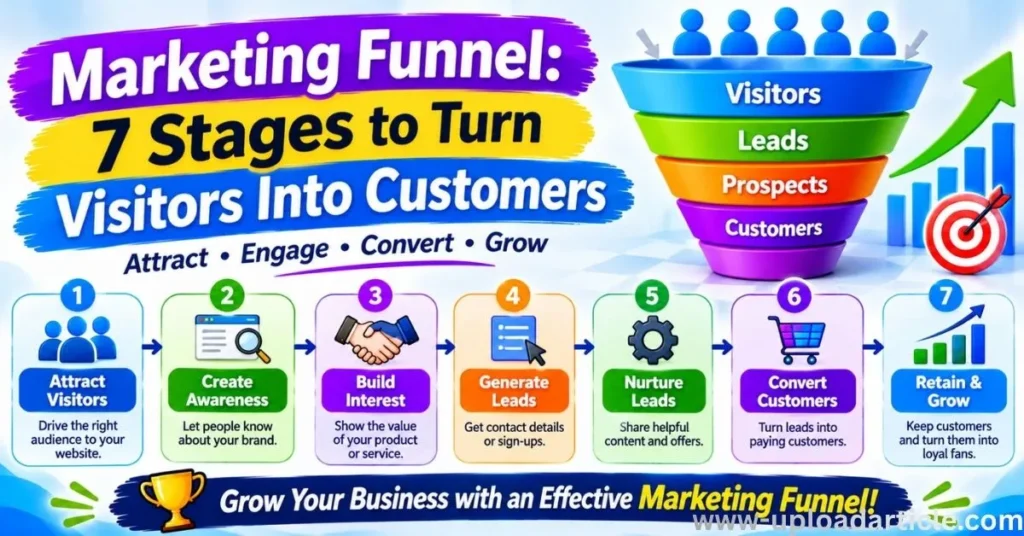
The following seven-stage model provides a practical way to understand the customer journey.
Stage 1: Awareness
Awareness is the first stage. At this point, people discover that a business, product, or service exists.
They may find a company through a Google search, social media post, online advertisement, recommendation, blog article, or video.
The main objective is to introduce the brand to the right audience.
Common marketing activities include:
- Search engine optimization.
- Social media content.
- Blog publishing.
- Video marketing.
- Public relations.
- Display advertising.
- Educational content.
For example, a person searching for “how to improve website speed” may discover a digital marketing website through an educational article.
At this stage, the visitor may not be interested in purchasing anything. They are simply looking for information.
How to improve awareness: Publish useful content that answers relevant questions, use appropriate keywords, maintain an active online presence, and reach audiences through channels that match their interests.
Stage 2: Interest
After discovering a business, some people become interested in learning more about it.
They may visit the website, explore product categories, read articles, watch videos, or follow the company’s social media accounts.
The objective is to provide information that encourages visitors to continue exploring.
Common marketing activities include:
- Detailed product or service pages.
- Educational blog posts.
- Email newsletter subscriptions.
- Explainer videos.
- Downloadable guides.
- Helpful social media content.
For example, someone who discovers a website through an article about website design may explore its other guides and services.
The business should make it easy for visitors to understand what it offers and why the information is relevant.
How to improve interest: Create clear website navigation, provide useful information, use relevant images, and make important pages easy to find.
Stage 3: Consideration
During the consideration stage, potential customers begin evaluating whether a product or service is suitable for their needs.
They may compare different companies, examine product features, read reviews, research prices, and look for evidence that a business can deliver what it promises.
At this stage, customers often need more detailed information before making a decision.
Common marketing activities include:
- Product comparisons.
- Case studies.
- Demonstrations.
- Customer testimonials.
- Frequently asked questions.
- Detailed service descriptions.
- Educational email campaigns.
For example, a small business looking for an SEO provider may compare several agencies based on services, experience, pricing, communication, and project scope.
How to improve consideration: Explain your products or services clearly, answer common questions, provide transparent pricing information where possible, and use genuine evidence to support your claims.
Stage 4: Intent
Intent is the stage where a potential customer shows stronger signs of wanting to make a purchase.
They may request a quotation, contact the sales team, sign up for a trial, add an item to a shopping cart, or visit a pricing page.
The business should recognize these actions and make the next step simple.
Common marketing activities include:
- Contact forms.
- Free consultations.
- Product demonstrations.
- Trial registrations.
- Pricing pages.
- Shopping cart reminders.
- Clear calls to action.
For example, a visitor who requests a quotation from a web development company has shown more purchase intent than someone who only reads a general article about website design.
How to improve intent: Use clear calls to action, reduce unnecessary form fields, explain the next step, and respond to inquiries promptly.
Stage 5: Evaluation
At the evaluation stage, potential customers make their final comparisons before choosing a product or service.
They may check delivery terms, service conditions, payment options, warranties, customer support, and the reputation of different providers.
Businesses should address any remaining concerns that could prevent a purchase.
Common marketing activities include:
- Detailed product specifications.
- Comparison charts.
- Consultation calls.
- Demonstrations.
- Transparent policies.
- Customer support.
- Relevant case studies.
For example, someone choosing between two website hosting providers may compare renewal costs, storage, website limits, support, and performance features.
How to improve evaluation: Provide accurate information, explain important differences, make policies easy to understand, and avoid exaggerated claims.
Stage 6: Conversion
Conversion is the stage where a potential customer completes a desired action.
That action may be purchasing a product, subscribing to a paid service, booking an appointment, or signing a contract.
The exact conversion depends on the business model.
Common marketing activities include:
- Simple checkout processes.
- Secure payment options.
- Clear pricing.
- Easy booking systems.
- Relevant product recommendations.
- Purchase confirmation messages.
- Helpful customer support.
For an online store, conversion may happen when a customer successfully completes checkout.
For a service business, conversion may mean accepting a proposal and becoming a paying client.
How to improve conversion: Make the process simple, explain costs clearly, provide trustworthy payment options, and remove unnecessary obstacles.
Stage 7: Retention and Advocacy
The customer journey should not end after the first purchase.
Retention focuses on encouraging existing customers to continue using a product or service. Advocacy happens when satisfied customers recommend a business to other people.
Both can support long-term business growth.
Common marketing activities include:
- Customer support.
- Follow-up emails.
- Loyalty programs.
- Helpful product updates.
- Educational resources.
- Feedback requests.
- Referral programs.
- Personalized offers.
For example, an online software company may send onboarding emails to new customers, provide tutorials, and offer support when users encounter problems.
A satisfied customer may later renew a subscription or recommend the software to colleagues.
How to improve retention: Deliver a good customer experience, provide useful support, listen to feedback, and communicate with customers in a relevant and respectful way.
Marketing Funnel Stages at a Glance
| Funnel Stage | Customer’s Main Question | Marketing Goal |
|---|---|---|
| Awareness | What is this business? | Introduce the brand |
| Interest | What does it offer? | Build interest |
| Consideration | Is it right for me? | Provide useful information |
| Intent | Should I take the next step? | Encourage action |
| Evaluation | Which option should I choose? | Address concerns |
| Conversion | Am I ready to buy? | Complete the desired action |
| Retention and Advocacy | Should I stay or recommend it? | Build lasting relationships |
The stages are a useful planning model, not a rule that every customer must follow in exactly the same order. Some people purchase quickly, while others may research a product for weeks or months.
Marketing Funnel Example for an Online Business
Consider a company that provides website design services to small businesses.
The company wants to attract business owners who need professional websites.
Here is how it might use a marketing funnel.
Awareness: Publish articles about website design, website costs, and common website problems. Share useful content on social media.
Interest: Create service pages explaining website design options, supported platforms, and the project process.
Consideration: Publish portfolio examples, explain design packages, and provide answers to common customer questions.
Intent: Add a consultation form so interested visitors can discuss their website requirements.
Evaluation: Send a clear proposal covering project scope, pricing, timeline, revisions, and support.
Conversion: The customer approves the proposal and pays according to the agreed terms.
Retention and Advocacy: Provide post-launch support, request feedback, and maintain communication about future improvements.
This example shows how different marketing activities can work together to guide potential customers toward a decision.
How to Build a Marketing Funnel for Your Business
Creating a marketing funnel does not require a complicated system. You can start with a simple plan and improve it as you understand your audience.
Step 1: Define Your Target Audience
First, identify the people most likely to need your product or service.
Consider:
- Age range, where relevant.
- Location.
- Industry or profession.
- Customer needs.
- Common problems.
- Budget considerations.
- Buying preferences.
A clear understanding of your audience helps you create more relevant marketing messages.
Step 2: Identify Your Marketing Goals
Decide what you want the funnel to achieve.
Examples include:
- Increasing website traffic.
- Generating email subscribers.
- Receiving more inquiries.
- Increasing product sales.
- Booking more consultations.
- Improving repeat purchases.
Choose goals that can be measured rather than relying on general statements such as “get more attention.”
Step 3: Select Suitable Marketing Channels
Choose channels based on where your target audience spends time and how they search for information.
Possible channels include:
- Google Search.
- Social media.
- Email marketing.
- Paid advertisements.
- Blog content.
- Video platforms.
- Referral programs.
You do not need to use every channel. Start with those most relevant to your audience and resources.
Step 4: Create Content for Every Stage
Different stages require different types of information.
For example:
| Stage | Suitable Content |
|---|---|
| Awareness | Blog posts, videos, social media posts |
| Interest | Guides, newsletters, service pages |
| Consideration | Comparisons, case studies, demonstrations |
| Intent | Contact forms, consultation pages |
| Evaluation | Proposals, FAQs, detailed pricing |
| Conversion | Checkout pages, booking forms |
| Retention | Tutorials, support content, follow-up emails |
The goal is to provide the right information when potential customers need it.
Step 5: Create Clear Calls to Action
A call to action (CTA) tells visitors what they can do next.
Examples include:
- Read the full guide.
- Download the checklist.
- Subscribe to the newsletter.
- Request a free consultation.
- View our services.
- Complete your purchase.
Make sure each CTA matches the visitor’s stage. Someone reading an introductory article may not be ready to purchase immediately.
Step 6: Choose Tools to Manage the Funnel
Marketing tools can help you understand visitor behavior and manage customer communication.
Common options include:
- Google Analytics 4 for website activity and conversions.
- Google Search Console for organic search performance.
- HubSpot for customer relationship management and marketing activities.
- Mailchimp for email marketing.
- Google Ads for paid search campaigns.
- Meta Ads Manager for Facebook and Instagram advertising.
Select tools according to your business requirements and budget.
Step 7: Measure and Improve Performance
Review your results regularly.
Identify where visitors leave the funnel, which pages attract attention, and which activities generate meaningful actions.
Test improvements such as clearer headlines, better landing pages, shorter forms, and more relevant calls to action.
A marketing funnel should be reviewed and improved as customer behavior and business needs change.
Important Marketing Funnel Metrics to Track
Measuring performance helps you understand whether your funnel is working.
Here are useful metrics for different stages.
Website Traffic
Website traffic shows how many visitors reach your website. You can also examine traffic sources to understand whether visitors come from organic search, paid advertisements, social media, referrals, or direct visits.
Engagement
Engagement measurements help you understand how visitors interact with your content.
Depending on the platform, you may review page views, engaged sessions, video views, email interactions, and social media engagement.
Lead Generation
Lead generation measurements may include form submissions, consultation requests, newsletter sign-ups, and other actions that show interest in a business.
Conversion Rate
Conversion rate measures the percentage of people who complete a selected action.
A basic calculation is:
Conversion Rate = (Number of Conversions ÷ Number of Visitors) × 100
For example, if 1,000 people visit a landing page and 40 complete the desired action:
Conversion Rate = (40 ÷ 1,000) × 100 = 4%
This example assumes all 1,000 visitors are included in the same measurement period and conversion definition.
Customer Acquisition Cost
Customer acquisition cost (CAC) estimates how much a business spends to acquire a customer.
A simplified calculation is:
CAC = Total Acquisition Costs ÷ Number of New Customers
Businesses should define which marketing and sales costs are included when calculating this metric.
Customer Retention
Retention measurements help businesses understand how many customers continue using their products or services over a selected period.
For subscription businesses, renewal and cancellation rates can be particularly useful.
Common Marketing Funnel Mistakes to Avoid
Even a well-designed funnel can perform poorly if important details are overlooked.
Attracting the Wrong Audience
Large amounts of traffic are not necessarily valuable if visitors have no interest in the business’s products or services.
Focus on relevant audiences rather than traffic numbers alone.
Using the Same Message for Everyone
People at different stages need different information.
A first-time visitor may need an educational guide, while someone comparing providers may need pricing details and case studies.
Making the Buying Process Complicated
Long forms, unclear pricing, confusing navigation, and unnecessary checkout steps can discourage potential customers.
Make important actions easy to understand and complete.
Ignoring Follow-Up Communication
Some potential customers need additional information before making a decision.
Relevant follow-up emails, helpful responses, and clear communication can support the decision-making process.
Measuring Only Website Traffic
Traffic is useful, but it does not explain the entire customer journey.
Track leads, conversions, acquisition costs, and retention to understand business results.
Forgetting Existing Customers
Marketing should not focus only on acquiring new customers. Existing customers may provide repeat purchases, renewals, referrals, and valuable feedback.
Marketing Funnel vs Sales Funnel: What Is the Difference?
Marketing funnels and sales funnels are closely related, but they often focus on different parts of the customer journey.
A marketing funnel generally focuses on attracting an audience, building awareness, developing interest, and generating potential customers.
A sales funnel often focuses on moving qualified prospects through the sales process until they make a purchase.
For example, the marketing team may attract visitors through SEO and advertising, then collect inquiries through a landing page.
The sales team may then contact qualified leads, discuss requirements, provide proposals, answer questions, and close deals.
In some organizations, the two funnels overlap or operate as one connected process.
The most important point is that marketing and sales teams should share information and work toward common business goals.
Is a Marketing Funnel Useful for Small Businesses?
Yes. Small businesses can use a marketing funnel without expensive software or a large marketing department.
A simple funnel might include:
- Publish useful articles to attract visitors.
- Create clear product or service pages.
- Offer a newsletter or contact form.
- Respond to inquiries.
- Provide clear prices and service information.
- Make purchasing or booking easy.
- Follow up with customers after a sale.
A small business can start with basic website analytics, an email platform, and a simple customer tracking system.
The important thing is to understand how potential customers discover the business and what helps them make a decision.
Conclusion
A marketing funnel helps businesses understand how potential customers discover a brand, learn about its products, evaluate available options, and make purchasing decisions.
Its seven stages awareness, interest, consideration, intent, evaluation, conversion, and retention and advocacy—provide a practical framework for planning marketing activities.
By creating useful content, selecting suitable marketing channels, making the buying process easier, and measuring performance, businesses can improve the customer journey and build stronger relationships.
Whether you operate a small business, an online store, or a digital marketing agency, a clear marketing funnel can help connect your marketing efforts with meaningful business results.
FAQs
What is a marketing funnel in simple words?
A marketing funnel is a model that explains how people move from discovering a business to becoming customers and potentially returning for future purchases.
What are the seven stages of a marketing funnel?
A practical seven-stage model includes awareness, interest, consideration, intent, evaluation, conversion, and retention and advocacy.
Why is a marketing funnel important?
It helps businesses understand customer behavior, organize marketing activities, identify problems in the buying journey, and improve the process of turning visitors into customers.
What is the difference between a marketing funnel and a sales funnel?
A marketing funnel generally focuses on attracting and developing potential customers, while a sales funnel focuses more directly on guiding qualified prospects toward a purchase. The two processes often work together.
Can a small business use a marketing funnel?
Yes. A small business can build a simple funnel using a website, useful content, contact forms, email communication, and customer follow-up.
What tools are used to create a marketing funnel?
Businesses may use Google Analytics 4, HubSpot, Mailchimp, Google Ads, Meta Ads Manager, landing page builders, and customer relationship management systems.
How do you measure marketing funnel performance?
Common measurements include website traffic, engagement, leads, conversion rates, customer acquisition cost, sales, and customer retention.
Does every customer follow the same marketing funnel?
No. Some customers make decisions quickly, while others compare several options or return to earlier stages before purchasing. The funnel is a planning model, not a fixed path followed by every person.