
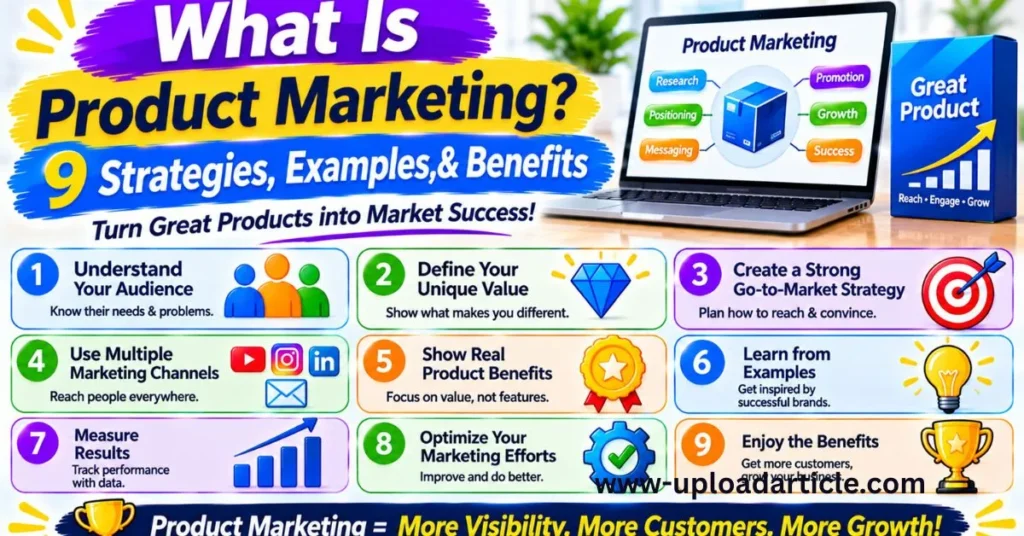
Every successful product needs more than an attractive design and useful features. Customers must understand what the product does, why it matters, and how it can solve their problems. This is where product marketing becomes important.
Businesses invest in product marketing to introduce products to the right audiences, communicate their value, generate demand, and encourage customers to make purchasing decisions. From technology companies launching software to small businesses promoting physical products, effective product marketing helps connect products with the people who need them.
But what is product marketing, how does it work, and why is it important for modern businesses?
Product marketing is the process of positioning, promoting, and communicating the value of a product to a specific target audience. It connects product development, marketing, sales, and customer experience to help a business successfully introduce and grow its products.
In this guide, you will learn about product marketing strategies, responsibilities, examples, benefits, essential skills, and the differences between product marketing and traditional marketing.
What Is Product Marketing?
Product marketing is a business function focused on bringing products to market and helping them succeed after launch. It involves understanding customer needs, researching competitors, developing product messaging, creating marketing campaigns, and supporting sales teams.
The primary goal is to communicate why a product is valuable and why customers should choose it over other available options.
For example, imagine a company develops a project management application. The application may offer task management, team collaboration, scheduling, and reporting features. However, simply listing these features may not convince customers to purchase it.
Product marketing explains how the application helps teams organize projects, reduce confusion, manage deadlines, and work more efficiently.
This approach connects product features with real customer benefits.
Main Elements of Product Marketing
Product marketing usually involves several important activities:
- Market research: Understanding customer needs, market demand, and industry trends.
- Customer segmentation: Identifying the audiences most likely to purchase the product.
- Product positioning: Establishing how a product should be understood in the market.
- Messaging: Explaining the product’s features, benefits, and unique value.
- Product launches: Planning and coordinating activities that introduce products to customers.
- Sales enablement: Providing sales teams with information and resources to communicate product value.
- Performance analysis: Measuring marketing results and identifying opportunities for improvement.
These activities help businesses create a consistent message throughout the customer journey.
Why Is Product Marketing Important?
Product marketing plays an important role because even a useful product can struggle if customers do not understand its purpose or benefits.
A business may develop an excellent product, but customers still need a reason to choose it. Product marketing helps explain that reason through clear communication, customer research, and effective promotional activities.
Here are some major reasons product marketing matters.
1. Helps Businesses Understand Customers
Customer research helps businesses understand what people need, what problems they experience, and what influences their purchasing decisions.
For example, a company selling fitness equipment may discover that some customers prioritize affordability while others prefer advanced features and durability.
Understanding these differences helps the business develop more relevant marketing messages.
2. Creates Strong Product Positioning
Product positioning explains how a product should be perceived compared with competing alternatives.
A business might position its product as affordable, premium, beginner-friendly, environmentally responsible, or designed for professionals.
Strong positioning makes it easier for customers to understand what makes a product different.
3. Communicates Product Benefits
Customers are generally more interested in how a product helps them than in a long list of technical specifications.
Product marketing translates product features into practical benefits.
For example:
- Feature: Automatic appointment reminders.
- Benefit: Customers are less likely to forget scheduled appointments.
- Feature: Cloud-based document storage.
- Benefit: Teams can access important files from different locations.
Clear benefit-focused messaging helps customers understand the product’s value.
4. Supports Successful Product Launches
Launching a product requires coordination between different business teams.
Product marketing helps organize launch messaging, promotional campaigns, customer education, sales resources, and communication channels.
A well-planned launch can help generate awareness and attract potential customers.
5. Helps Businesses Compete in the Market
Customers often compare several products before making a purchase.
Product marketing helps businesses understand competitors, identify market opportunities, and explain their product’s strengths.
Rather than simply claiming that a product is better, companies can communicate specific advantages supported by evidence.
9 Effective Product Marketing Strategies
A successful product marketing plan requires a combination of research, positioning, communication, promotion, and measurement.
The following nine strategies can help businesses introduce products and build stronger relationships with customers.
1. Conduct Market Research
Market research is the foundation of effective product marketing. Before promoting a product, businesses should understand the market and the people they want to reach.
Research can include customer surveys, interviews, competitor analysis, industry reports, and online discussions.
For example, a company planning to launch a budgeting application may research how people currently manage expenses, which features they prefer, and what problems they experience with existing applications.
Useful research questions include:
- Who is most likely to purchase the product?
- What problems does the product solve?
- Which alternatives are customers currently using?
- What influences purchasing decisions?
- What are the biggest customer frustrations?
The answers help businesses make more informed product and marketing decisions.
2. Identify Your Target Audience
Not every product is designed for every customer. Identifying the right audience helps businesses focus their resources on people who are most likely to benefit from the product.
A target audience can be defined using characteristics such as:
- Age range
- Location
- Professional background
- Interests
- Purchasing behavior
- Business size
- Customer needs
- Budget
For example, a software company offering accounting tools may target freelancers, small businesses, and independent professionals.
Each group may have different needs. Freelancers might prioritize simple invoicing, while larger businesses may need reporting and team management features.
Understanding these differences helps create more relevant campaigns.
3. Develop a Clear Product Positioning Strategy
Product positioning establishes the place a product should occupy in customers’ minds.
It answers an important question: Why should someone choose this product instead of another option?
A positioning strategy should explain:
- Who the product is designed for.
- What problem it solves.
- What makes it different.
- What benefits customers receive.
- Why customers should trust the product.
For example, a project management application might position itself as an easy-to-use solution for small remote teams.
This message is more specific than simply describing the application as a productivity tool.
4. Create Compelling Product Messaging
Product messaging communicates the product’s value through website content, advertisements, landing pages, emails, social media, and sales materials.
Effective messaging should be simple, relevant, and focused on customer benefits.
Consider a company selling an online language-learning application.
A feature-focused message might say:
“Our application includes interactive lessons and vocabulary exercises.”
A benefit-focused message could say:
“Practice a new language through short interactive lessons that fit your daily schedule.”
The second message explains how the product can help the customer.
Businesses should maintain consistent messaging across their marketing channels so customers receive the same core message wherever they discover the product.
5. Build a Strong Product Launch Plan
A product launch introduces a new product or major update to its intended audience.
A successful launch usually requires preparation before the product becomes publicly available.
A launch plan may include:
Pre-launch activities:
- Research the target audience.
- Prepare product descriptions and landing pages.
- Create promotional materials.
- Develop an email announcement.
- Train the sales and customer support teams.
Launch activities:
- Publish the product announcement.
- Activate advertising campaigns.
- Share demonstrations and tutorials.
- Communicate with existing customers.
- Monitor customer questions and feedback.
Post-launch activities:
- Review campaign performance.
- Collect customer feedback.
- Identify product issues.
- Improve messaging.
- Adjust marketing campaigns.
Planning all three stages helps businesses maintain momentum beyond launch day.
6. Use Content Marketing to Educate Customers
Content marketing supports product marketing by helping potential customers understand their problems and explore possible solutions.
Businesses can publish useful educational content instead of relying entirely on direct promotional messages.
Examples include:
- Blog articles
- Product tutorials
- Comparison guides
- Case studies
- Demonstration videos
- Frequently asked questions
- Downloadable guides
For example, a cybersecurity company might publish an article explaining common online security risks and then introduce its security software as one possible solution.
Educational content can attract relevant visitors, build trust, and support purchasing decisions.
7. Support Your Sales Team
Product marketing is not limited to attracting website visitors or generating social media engagement. It also helps sales teams communicate product value.
Sales representatives need accurate information about product features, customer benefits, pricing, competitors, and common objections.
Product marketing teams can prepare:
- Product presentation slides
- Sales guides
- Product comparison sheets
- Demonstration scripts
- Frequently asked questions
- Customer success stories
- Competitive positioning documents
These resources help sales representatives explain the product more confidently and answer customer questions consistently.
8. Collect Customer Feedback and Improve Messaging
Customer feedback provides valuable information about how people experience a product.
Businesses can collect feedback through surveys, reviews, interviews, customer support conversations, and product usage data.
For example, customers may repeatedly ask whether a software application works on mobile devices. This could indicate that the business needs clearer website messaging about mobile compatibility.
Feedback can also reveal missing features, usability problems, and customer expectations.
Product marketing teams should share these insights with product managers and other relevant departments.
9. Measure Product Marketing Performance
Measuring results helps businesses understand whether their marketing activities are producing meaningful outcomes.
The right performance indicators depend on the product, business model, and marketing objectives.
Common product marketing metrics include:
| Metric | What It Measures |
|---|---|
| Product awareness | How familiar the target audience is with the product |
| Website traffic | Visitors reaching product pages |
| Conversion rate | Percentage of visitors completing a desired action |
| Customer acquisition cost | Cost of acquiring a customer |
| Trial-to-paid conversion | Percentage of trial users becoming paying customers |
| Customer retention | How effectively customers continue using the product |
| Customer feedback | Customer satisfaction and product perceptions |
Businesses should select metrics that connect directly to their goals rather than tracking numbers simply because they are easy to measure.
Product Marketing Examples
Understanding product marketing becomes easier when you look at how businesses communicate the value of different products.
Here are some practical examples from different industries.
Example 1: Smartphone Product Marketing
A smartphone manufacturer may promote a new device by highlighting its camera, battery, display, and processing performance.
However, effective product marketing goes beyond technical specifications.
The company might demonstrate how the camera helps users capture clear photos, how the battery supports longer daily use, and how the display improves the entertainment experience.
These messages connect technical features with customer benefits.
Example 2: Software Product Marketing
A software company launching an online project management platform may target small businesses and remote teams.
Its product marketing campaign could include:
- A product demonstration.
- A free trial.
- Educational blog content.
- Customer testimonials, when genuine and authorized.
- Comparison pages.
- Email campaigns.
The messaging would focus on helping teams organize tasks and collaborate more effectively.
Example 3: E-commerce Product Marketing
An online clothing store may introduce a new collection by identifying its target customers and explaining what makes the products appealing.
Its marketing could include product photography, detailed descriptions, social media promotions, email announcements, and customer reviews.
The goal is to communicate the product’s value and make the purchasing process easier.
Example 4: Food and Beverage Product Marketing
A food company launching a new healthy snack might focus on ingredients, convenience, taste, packaging, and the needs of its intended audience.
The business could use product samples, retail promotions, social media campaigns, and informative packaging to introduce the product.
Any nutritional or health-related claims should be accurate and supported by appropriate evidence.
Product Marketing vs. Traditional Marketing
Product marketing and traditional marketing are closely related, but they do not always have the same focus.
Traditional marketing generally promotes a company’s brand, products, or services through different channels. Product marketing focuses more specifically on positioning a particular product, communicating its value, supporting its launch, and helping it succeed in the market.
| Area | Product Marketing | Traditional Marketing |
|---|---|---|
| Main focus | A specific product or product line | Brand, company, products, or services |
| Audience | Customers for a particular product | Broader target audiences |
| Messaging | Product value and differentiation | Brand awareness and campaign messaging |
| Research | Product needs and competitive positioning | Market and audience research |
| Launch planning | Product introduction and adoption | Campaign or brand promotion |
| Sales support | Product education and sales materials | Depends on the marketing function |
Both functions can work together to strengthen brand awareness and business growth.
Product Marketing vs. Product Management
Product marketing is also different from product management, although both departments often collaborate.
Product management generally focuses on deciding what a product should do, how it should develop, and which problems it should solve.
Product marketing focuses on understanding the market, communicating the product’s value, and helping customers discover and adopt it.
For example, a product manager may work with developers to introduce a new feature in a software application. A product marketer may research customer demand for that feature and prepare the messaging used to announce it.
| Product Marketing | Product Management |
|---|---|
| Focuses on market positioning | Focuses on product direction |
| Researches customers and competitors | Researches product needs and requirements |
| Creates product messaging | Defines product features and priorities |
| Plans product launches | Coordinates product development |
| Supports sales and marketing | Coordinates product teams |
The two functions share information and collaborate throughout the product lifecycle.
What Does a Product Marketing Manager Do?
A product marketing manager is responsible for developing and coordinating marketing activities that help a product reach its target customers.
The exact responsibilities depend on the company and industry, but the role commonly includes the following tasks:
Market and Customer Research
A product marketing manager studies customer needs, market trends, competitor products, and purchasing behavior.
Product Positioning
They develop clear messages explaining what a product offers, who should use it, and why it is different.
Go-to-Market Planning
They coordinate launch activities, promotional campaigns, communication plans, and customer education.
Sales Enablement
They prepare product information, sales presentations, comparison materials, and other resources for sales teams.
Cross-Department Collaboration
They work with product managers, designers, sales representatives, customer support teams, and marketing professionals.
Performance Monitoring
They analyze campaign performance, customer feedback, conversion rates, and other relevant metrics to identify improvements.
Essential Product Marketing Skills
Product marketing requires a combination of communication, research, strategic thinking, and analytical abilities.
Some of the most useful skills include:
1. Communication: The ability to explain complex product information in clear and understandable language.
2. Market research: Understanding customer expectations, competitors, and industry developments.
3. Strategic thinking: Developing product positioning and marketing plans that support business objectives.
4. Content creation: Preparing product descriptions, landing pages, presentations, and educational materials.
5. Data analysis: Understanding marketing performance and identifying opportunities for improvement.
6. Collaboration: Working effectively with product, sales, design, and marketing teams.
7. Customer understanding: Recognizing customer problems and explaining how a product can address them.
8. Project management: Organizing launch activities, deadlines, and communication across different departments.
These skills are useful for people interested in product marketing careers and for business owners managing their own product promotions.
Product Marketing Tools
Businesses use different tools to research audiences, create content, manage campaigns, and measure results.
The most suitable tools depend on the company’s budget, team size, and marketing requirements.
| Tool | Common Purpose |
|---|---|
| Google Analytics | Website traffic and visitor behavior analysis |
| Google Trends | Exploring search interest over time |
| Google Search Console | Monitoring website search performance |
| HubSpot | Customer relationship management and marketing activities |
| Semrush | SEO and competitor research |
| Ahrefs | Keyword and backlink research |
| Canva | Creating marketing graphics and presentations |
| Mailchimp | Email marketing campaigns |
| SurveyMonkey | Collecting customer feedback |
These tools support different parts of the marketing process. They do not replace customer research, clear positioning, or a well-planned marketing strategy.
Common Product Marketing Mistakes to Avoid
Even businesses with useful products can make mistakes when planning their marketing activities.
Here are some common problems to avoid.
Focusing Only on Product Features
Listing features without explaining customer benefits makes it harder for potential buyers to understand the product’s value.
Ignoring Competitor Research
Businesses that fail to study alternatives may struggle to communicate meaningful differences.
Targeting Everyone
Trying to reach every possible customer can make marketing messages too broad. A clearly defined target audience usually supports more relevant communication.
Making Unsupported Claims
Promotional messages should be accurate. Businesses should avoid exaggerated performance promises, misleading comparisons, and unverified customer results.
Neglecting Customer Feedback
Ignoring customer questions and complaints can prevent businesses from identifying problems and improving their messaging.
Failing to Measure Results
Without relevant performance metrics, businesses may continue spending money on activities that do not support their objectives.
Avoiding these mistakes helps create a more focused and effective product marketing process.
How to Create a Product Marketing Plan
A product marketing plan gives a business a clear direction for introducing and promoting a product.
You can start with the following steps:
- Define the product: Identify its purpose, features, benefits, and limitations.
- Research the market: Understand customer needs and competing alternatives.
- Select your target audience: Identify the customers most likely to benefit from the product.
- Develop positioning: Explain what makes the product relevant and different.
- Create messaging: Prepare clear product descriptions and customer-focused communication.
- Choose marketing channels: Select appropriate platforms such as search engines, email, social media, and advertising.
- Prepare the launch: Organize promotional materials, sales resources, and customer support.
- Monitor performance: Review results and collect customer feedback.
- Improve the strategy: Adjust messaging, campaigns, and activities based on what you learn.
A product marketing plan should be reviewed regularly because customer expectations, competition, and market conditions can change.
Conclusion
Product marketing helps businesses connect useful products with the customers who need them. It involves understanding the market, identifying target audiences, developing clear positioning, communicating product benefits, planning launches, and measuring results.
Whether a business sells software, smartphones, clothing, or professional services, a well-organized product marketing strategy can make its offerings easier to understand and more relevant to potential customers.
By applying the nine strategies discussed in this guide, businesses can improve product communication, support sales teams, understand customer expectations, and make better marketing decisions.
Ultimately, successful product marketing is not simply about telling people that a product exists. It is about showing the right audience why that product matters and how it can provide meaningful value.
FAQs
What is product marketing in simple words?
Product marketing means promoting a product by explaining its value, benefits, and usefulness to the right customers. It helps people understand why they may need a product and why they should consider buying it.
What is the main goal of product marketing?
The main goal is to connect a product with its target audience, communicate its value, support product launches, and encourage customer adoption and business growth.
What are the 4 Ps of product marketing?
The traditional marketing mix includes Product, Price, Place, and Promotion. These four elements help businesses plan what they sell, how they price it, where customers can access it, and how they promote it.
What is an example of product marketing?
A smartphone company introducing a new device through product demonstrations, feature explanations, advertisements, comparison pages, and launch campaigns is an example of product marketing.
What does a product marketing manager do?
A product marketing manager researches customers and competitors, develops product positioning, creates messaging, plans launches, supports sales teams, and monitors marketing performance.
Is product marketing the same as digital marketing?
No. Digital marketing uses online channels such as search engines, websites, email, and social media to promote products or services. Product marketing is a broader function focused on product positioning, messaging, launches, and customer adoption. Digital channels can be part of a product marketing strategy.
What skills are needed for product marketing?
Important skills include communication, market research, customer understanding, strategic planning, content creation, data analysis, collaboration, and project management.