
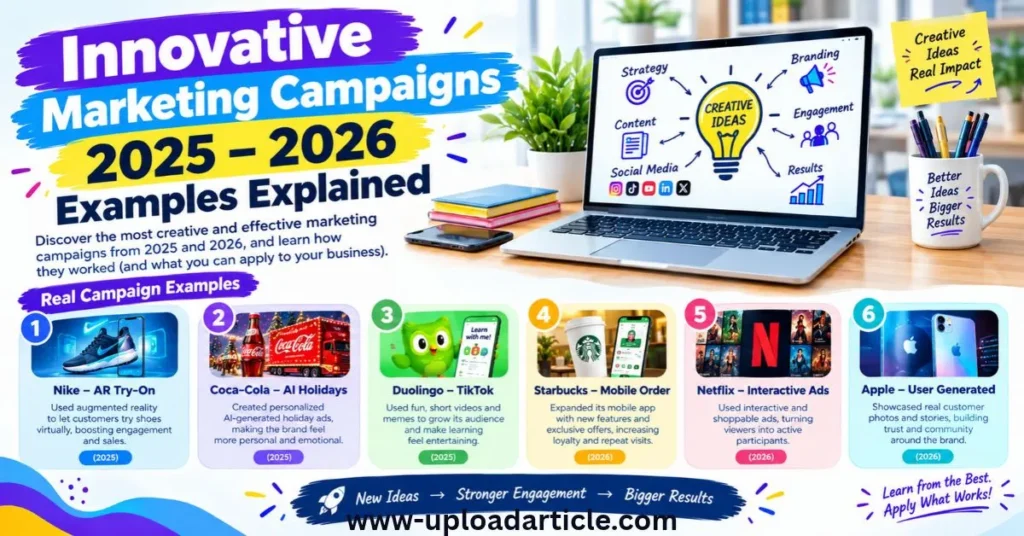
Marketing is changing quickly, and the most memorable campaigns are no longer limited to television advertisements, celebrity endorsements, or traditional social media promotions. Brands are finding new ways to attract attention through interactive experiences, artificial intelligence, personalized content, creative storytelling, and campaigns that encourage customers to participate.
The most innovative marketing campaigns of 2025 and 2026 demonstrate an important lesson: creativity works best when it gives people a reason to care, participate, or share an experience. Some brands have turned real-world events into marketing opportunities, while others have used technology to make advertising more interactive or changed their products and services to address customer needs.
In this guide, we explore 12 innovative marketing campaigns 2025 2026 examples, explain what made each approach distinctive, and share practical lessons that businesses can apply to their own marketing strategies.
What Makes a Marketing Campaign Innovative?
An innovative marketing campaign introduces a fresh way to communicate a message, solve a customer problem, encourage participation, or connect a product with its intended audience. Innovation does not necessarily require expensive technology or a large advertising budget. Sometimes, a simple idea presented at the right moment can generate more interest than a conventional advertising campaign.
Successful campaigns often combine creativity with a clear business objective. A company might want to increase brand awareness, introduce a new product, generate leads, improve customer loyalty, or encourage more purchases. The creative concept should support that objective rather than attract attention without delivering meaningful value.
Another important characteristic is audience participation. Instead of simply watching an advertisement, customers might create content, personalize a product, interact with an application, join a challenge, or contribute to a shared story. When a campaign gives people a memorable experience, they have a stronger reason to discuss it with others.
1. Duolingo: The Death of Duo Campaign (2025)
Duolingo attracted widespread attention in February 2025 when it announced the fictional death of Duo, its recognizable green owl mascot. Rather than using a conventional advertisement to promote language learning, the brand developed a playful story across its social media channels.
The announcement became an interactive narrative involving audience reactions, brand conversations, and a challenge encouraging users to complete lessons as part of the story. The campaign turned a familiar character into the center of an unfolding event, giving followers a reason to return and participate instead of seeing just one promotional post.
The creative strength of the campaign was its connection with an existing audience. Duolingo had already established a recognizable social media personality, so the fictional event felt consistent with its playful brand identity. The story also gave users something to discuss, share, and respond to.
Marketing lesson: Build campaigns around an established brand personality. Small businesses can create recurring characters, community challenges, or serialized social media stories that encourage audiences to return. However, the concept should fit the brand naturally rather than imitate a viral trend without a clear purpose.
2. Coca-Cola: Share a Coke Returns (2025)
Coca-Cola brought back its well-known Share a Coke campaign in 2025, refreshing the personalized packaging concept for a new generation of consumers. The original idea replaced the familiar logo on selected bottles and cans with popular first names, encouraging customers to find products associated with friends and family members.
The 2025 version combined personalized packaging with digital experiences and sharing opportunities. The campaign encouraged people to discover names, give drinks to others, and create personal moments around an everyday product. Coca-Cola announced the new global rollout in March 2025, with participating markets receiving personalized packaging and digital features. Official campaign announcement.
What makes this campaign innovative is the way it transforms a routine purchase into a personal experience. Instead of communicating only through a traditional advertisement, the product packaging itself becomes part of the marketing message. Customers can also become part of the campaign by sharing photographs and stories about their personalized drinks.
Marketing lesson: Personalization can make ordinary products more meaningful. Businesses can use customers’ names, customized recommendations, tailored offers, or personalized messages to make their marketing feel more relevant. The experience should be convenient and respectful of customer privacy.
3. AXA: Three Words Campaign (2025)
AXA France demonstrated how marketing can become more powerful when a company changes the actual customer experience instead of relying only on advertising. Its Three Words campaign addressed domestic violence through a change to its home insurance coverage.
The initiative added domestic violence as a covered risk under the relevant home insurance policies, enabling eligible customers to access support that included emergency relocation and legal, psychological, and financial assistance. The campaign launched in 2025 and received major recognition at the Cannes Lions International Festival of Creativity.
Its distinguishing feature was the connection between the advertising message and a practical service change. Rather than simply expressing support for people facing a serious problem, the company connected its message to assistance that eligible customers could use.
The approach illustrates how a brand can build a meaningful campaign around a genuine improvement to its product or service. It also demonstrates why social-impact marketing needs substance behind its message.
Marketing lesson: Before creating a promotional campaign, examine whether your business can improve the customer experience in a meaningful way. Better support, clearer policies, easier access, or a useful new service can provide a stronger foundation for marketing than an emotional message alone.
4. Gap: Better in Denim (2025)
Gap’s Better in Denim campaign used music, fashion, choreography, and social video to promote its denim collection. The campaign featured the global girl group KATSEYE and presented denim through energetic movement and contemporary pop culture rather than relying solely on conventional product photography.
The campaign was designed to connect with younger audiences through video platforms and social sharing. Dance-led creative content gives viewers an experience they can watch, discuss, and potentially recreate. It also allows clothing to appear naturally within an entertaining performance.
The strategy demonstrates how brands can combine product visibility with culture and entertainment. Instead of treating a product as the only subject of an advertisement, the campaign places it inside a broader experience that audiences may already enjoy.
Marketing lesson: Make your product part of content people genuinely want to watch. Fashion businesses can use styling challenges, while food brands might create recipes and fitness businesses might develop practical workout demonstrations. Entertainment should support the product rather than distract from it.
5. Vaseline: Vaseline Verified (2025)
Vaseline Verified connected brand marketing with the skincare tips and product hacks people share online. Rather than ignoring social media discussions, the campaign focused on examining popular Vaseline-related claims and testing selected ideas to establish which uses were supported by evidence.
This approach made customer curiosity part of the creative strategy. People were already encountering skincare advice online, so the brand had an opportunity to participate in those conversations with product knowledge and educational content.
The campaign also highlights the importance of credibility in categories where misleading advice can affect consumer decisions. A brand can attract attention by addressing common questions, but it needs to distinguish evidence-based information from unsupported claims.
Marketing lesson: Turn frequently asked customer questions into useful marketing content. Businesses can produce demonstrations, expert explanations, myth-versus-fact posts, and product comparisons. Accuracy matters, especially when content relates to health, safety, finance, or other sensitive subjects.
6. KitKat: Phone Break (2025)
KitKat’s Phone Break campaign refreshed its long-standing association with taking a break. The outdoor creative used the familiar shape of KitKat bars as a visual substitute for smartphones, creating an immediately understandable connection between the product and the habit of stepping away from a screen.
The idea did not depend on lengthy explanations. Its visual simplicity connected the product with a recognizable modern behavior: people frequently check their phones even when they have an opportunity to relax.
This type of advertising demonstrates how a familiar brand message can be updated for contemporary audiences. The concept draws on an existing brand association while using a current cultural observation to make the message feel relevant.
Marketing lesson: Review your brand’s most recognizable message before replacing it with something completely new. A strong campaign can reinterpret a familiar idea through current customer behavior, new formats, or unexpected visual comparisons.
7. Canva: Make the Logo Bigger (2025)
Canva used outdoor advertising to demonstrate its design capabilities through a creative takeover involving 14 sites at London’s Waterloo station. The campaign drew on a familiar request that designers often encounter: making a logo bigger.
Instead of simply displaying a conventional product advertisement, the creative execution used design-related humor and the outdoor environment to demonstrate the kind of work Canva helps people create.
This approach made the advertising format part of the message. The campaign did not merely tell people that Canva supports visual design; it used a public display to illustrate a recognizable design challenge.
The idea also shows how business-to-business and software companies can communicate complex products through relatable situations rather than technical explanations alone.
Marketing lesson: Demonstrate your product’s capabilities through the advertisement itself. A web design agency can showcase before-and-after website layouts, while an SEO company can explain a technical concept through a clear visual example. Useful demonstrations help potential customers understand the value being offered.
8. GoDaddy: Act Like You Know (2025)
GoDaddy’s Act Like You Know campaign featured actor Walton Goggins and a fictional eyewear business to promote GoDaddy Airo, its AI-powered set of tools for entrepreneurs and small businesses.
The creative approach used humor and a fictional business story to make website-building and business-support technology more approachable. Rather than presenting a list of software features, the campaign showed a recognizable business scenario in which the tools could play a role.
This is useful because many potential customers find technology products difficult to evaluate. They may understand that a tool offers AI features without knowing how those features could help them launch a website, develop branding, or begin promoting a business.
Marketing lesson: Explain technical products through realistic customer situations. Software companies can use short demonstrations, fictional business scenarios, or customer stories to show how their products solve practical problems. Avoid promising outcomes that the product cannot reliably deliver.
9. Coca-Cola: Feel It All for FIFA World Cup 2026
Coca-Cola developed its Feel It All campaign around the emotional experience of football fandom ahead of the 2026 FIFA World Cup. The campaign included a sequence of films, culminating in No Better Feeling, which the company unveiled in June 2026.
The creative direction focused on the tension, anticipation, disappointment, and excitement that supporters experience while watching football. Instead of communicating only product attributes, the campaign connected the brand with a major shared cultural experience.
Coca-Cola also supported the broader campaign with activities such as the FIFA World Cup Trophy Tour, a sticker partnership, and fan experiences across the tournament’s 16 host cities in the United States, Canada, and Mexico. Official campaign details.
The strategy illustrates the value of connecting a brand with a moment that matters to its audience. Football supporters do not simply watch matches; they develop memories, rituals, and emotional connections around them.
Marketing lesson: Find the cultural moments that naturally connect with your customers. A small business might build a campaign around a local festival, a seasonal event, or an important community activity. Relevance is more valuable than attaching a brand to every trending topic.
10. KitKat: The KitKat Heist (2026)
In 2026, KitKat turned a real-world incident involving the theft of more than 413,000 chocolate bars in transit between Italy and Poland into an unexpected brand conversation.
The company responded with humor and transparency, connecting the incident to its famous break-themed slogan. The response developed into a broader campaign that included a Stolen KitKat Tracker, giving people a way to follow the story and participate in the conversation.
Nestlé reported that the campaign received multiple awards at Cannes Lions 2026, including a Grand Prix, four Gold Lions, and four Silver Lions. These awards recognized the campaign’s creative execution, although awards alone should not be treated as proof of a particular sales increase. Nestlé’s campaign announcement.
The campaign illustrates how brands can respond creatively when unexpected events attract public attention. Its effectiveness depended on the close relationship between the incident and KitKat’s established brand identity.
Marketing lesson: Prepare to respond quickly when a relevant opportunity emerges, but use judgment. A real-world incident is not automatically suitable for marketing. Brands should avoid exploiting victims, making unsupported claims, or turning serious situations into inappropriate jokes.
11. Uber Eats: Build Your Own Super Bowl Commercial (2026)
Uber Eats and its creative partners developed an interactive campaign that allowed users to create their own Super Bowl commercials featuring Hollywood celebrities through the Uber Eats app. The experience connected entertainment, advertising, and app-based participation.
The concept moved beyond the usual model in which viewers passively watch a finished advertisement. By giving users a creative role, the campaign made the advertising experience itself part of the attraction.
The campaign received the Media Grand Prix at Cannes Lions 2026, according to Australia’s Advertising Council. The recognition highlighted its combination of creativity, technology, and media strategy. Campaign award coverage.
The example shows how an app can become more than a place to complete transactions. When the experience is designed well, it can also become a platform for entertainment, engagement, and brand interaction.
Marketing lesson: Look for ways to let customers participate rather than simply receive your message. Depending on the business, this could mean a product configurator, interactive quiz, design tool, personalized offer, or campaign where users submit their own creative ideas.
12. Lipton, BeReal, and OMD: The Fake BeReal Campaign (2026)
Lipton, BeReal, and media agency OMD developed a campaign promoting Lipton Ice Tea Sparkling to younger audiences by reimagining BeReal’s recognizable front-and-back camera format.
The creative idea used an optical illusion that made a person appear to reach through one camera view to grab a bottle visible in the other. This transformed a familiar social media format into an entertaining product demonstration.
According to BeReal’s May 2026 announcement, the campaign achieved an 11-point increase in ad recall, a five-point increase in purchase intent, and an 8% completion rate for a 15-second video format. These are reported campaign results, not universal benchmarks for other advertisers. Read the campaign announcement.
The campaign’s strength came from designing the creative around the platform’s familiar format. Instead of adapting a conventional television commercial for social media, the team developed an idea that used the medium itself.
Marketing lesson: Understand how people use a platform before creating content for it. A campaign designed specifically for short-form video, messaging, or interactive social experiences can feel more natural than the same advertisement repeated across every channel.
The Biggest Innovative Marketing Trends in 2025 and 2026
Looking across these examples, several patterns stand out. The first is participation. Campaigns such as Uber Eats’ interactive advertisement and Duolingo’s ongoing story gave audiences something to do rather than merely something to watch.
The second is cultural relevance. KitKat connected its messaging to familiar ideas about taking breaks, while Coca-Cola connected its World Cup campaign to the emotions surrounding football. Such campaigns work best when the cultural connection feels natural to the brand.
The third is practical value. AXA connected its campaign with a change in insurance coverage, while Vaseline focused on examining popular skincare advice. These examples show that marketing can become more meaningful when it answers a real question or improves a customer experience.
Artificial intelligence and interactive technology also offer new possibilities. However, technology is not automatically innovative. A campaign needs a clear reason for using a particular tool or platform. If the technology does not improve the experience, explain the product, or support a business goal, it may add complexity without adding value.
Finally, strong campaigns need measurement. Views and social engagement can indicate attention, but businesses should also examine qualified leads, sales, customer acquisition costs, conversions, and customer retention. The most useful measurement depends on the campaign’s objective.
How Small Businesses Can Create Innovative Marketing Campaigns
Small businesses do not need a multinational advertising budget to develop a creative campaign. They can start with a specific customer problem, a clear message, and one channel that suits their audience.
First, define the goal. A campaign designed to attract website visitors will require a different approach from one intended to generate sales or build customer loyalty. Decide what success means before choosing the creative idea.
Second, research your audience. Look at customer questions, product reviews, social media conversations, and the problems people are trying to solve. These sources can help identify useful campaign concepts without relying entirely on guesswork.
Third, choose a format that fits the idea. A short demonstration may suit a software product, while a personalized experience may be more effective for a gift business. A local service provider could use a customer story, a community event, or a useful educational series.
Fourth, create content people have a reason to share. This could be an entertaining demonstration, a practical checklist, a personalized result, or a challenge that customers can complete themselves. Sharing should be a natural extension of the experience rather than the only objective.
Fifth, test and measure the campaign. Begin with a manageable budget, compare different creative versions, and monitor the metrics connected to your goal. Use the results to improve the campaign instead of assuming the first idea will perform best.
How to Measure the Success of an Innovative Marketing Campaign
A creative campaign should be evaluated according to what it was designed to achieve. Brand-awareness campaigns may focus on reach, relevant impressions, branded searches, and changes in brand recall. Lead-generation campaigns should pay closer attention to qualified enquiries, conversion rates, and cost per lead.
For e-commerce businesses, useful metrics may include sales, average order value, repeat purchases, and customer acquisition costs. For social campaigns, engagement, completion rates, shares, and audience sentiment can provide additional context.
It is important to distinguish attention from business impact. A video may attract millions of views without generating meaningful sales, while a smaller campaign may produce fewer views but bring in highly qualified customers. Neither reach nor engagement should be interpreted in isolation.
Where possible, compare performance with a previous period, a relevant baseline, or a control group. This helps determine whether a campaign contributed to an improvement rather than simply occurring at the same time as one.
Common Mistakes to Avoid When Creating Innovative Campaigns
One common mistake is copying a famous campaign without understanding why it worked. Duolingo’s mascot-led storytelling fits its existing brand personality, but the same approach may feel unnatural for a company whose customers expect a serious, professional service.
Another mistake is prioritizing virality over relevance. A campaign can attract attention while failing to communicate what the business offers. Every creative element should support a recognizable message and a meaningful objective.
Businesses should also avoid exaggerating campaign results. Reported views, awards, and engagement figures can be useful, but they do not automatically demonstrate revenue growth or profitability. Use verified figures and clearly explain what each metric represents.
Finally, avoid adopting new technology simply because it is popular. AI tools, interactive content, and automation can be valuable when they improve the customer experience or make marketing more effective. They are not substitutes for understanding your audience.
Conclusion
The innovative marketing campaigns of 2025 and 2026 show that effective marketing can take many forms. Brands can use personalized products, interactive technology, entertaining stories, cultural moments, or meaningful service improvements to build stronger connections with customers.
The most important lesson is not to copy the biggest brands or chase every new trend. Instead, identify what matters to your audience, create an experience that supports your business goals, and measure whether the campaign produces meaningful results.
Whether you run a small business, manage a digital marketing agency, or work for an established brand, the strongest campaign idea is one that connects creativity with customer value. Start with a clear problem, develop a distinctive solution, and make every part of the campaign support that purpose.
FAQs
What are innovative marketing campaigns?
Innovative marketing campaigns use creative ideas, new formats, technology, personalization, or customer participation to promote a product, service, or brand in a distinctive way. Their purpose is to attract relevant attention and support a measurable business objective.
What are some examples of innovative marketing campaigns in 2025?
Examples include Duolingo’s Death of Duo campaign, Coca-Cola’s return of Share a Coke, AXA’s Three Words campaign, Gap’s Better in Denim, Vaseline Verified, and KitKat’s Phone Break. Each used a different approach to connect with its audience.
What are some innovative marketing campaigns from 2026?
Notable examples include KitKat’s The KitKat Heist, Uber Eats’ Build Your Own Super Bowl Commercial, Lipton and BeReal’s Fake BeReal campaign, and Coca-Cola’s Feel It All campaign for the FIFA World Cup 2026.
How can a small business create an innovative marketing campaign?
Start by identifying a customer problem, defining a clear goal, and choosing a creative format that fits your audience. Use existing customer questions and feedback to develop the idea, then test it on a manageable budget and measure the results.
Is AI necessary for innovative marketing?
No. AI can help with personalization, content production, customer support, and data analysis, but innovation does not require AI. A useful product improvement, memorable story, or well-designed customer experience can be just as innovative.
How do you measure marketing campaign effectiveness?
Measure performance against the campaign’s objective. Useful metrics may include brand awareness, engagement, website traffic, qualified leads, conversion rates, sales, and customer acquisition costs. Use verified data and avoid treating views or awards as proof of financial success.
What makes a marketing campaign memorable?
A memorable campaign usually combines a clear idea with relevance, emotion, usefulness, surprise, or participation. It also fits the brand’s identity and gives the audience a reason to remember or discuss it.