
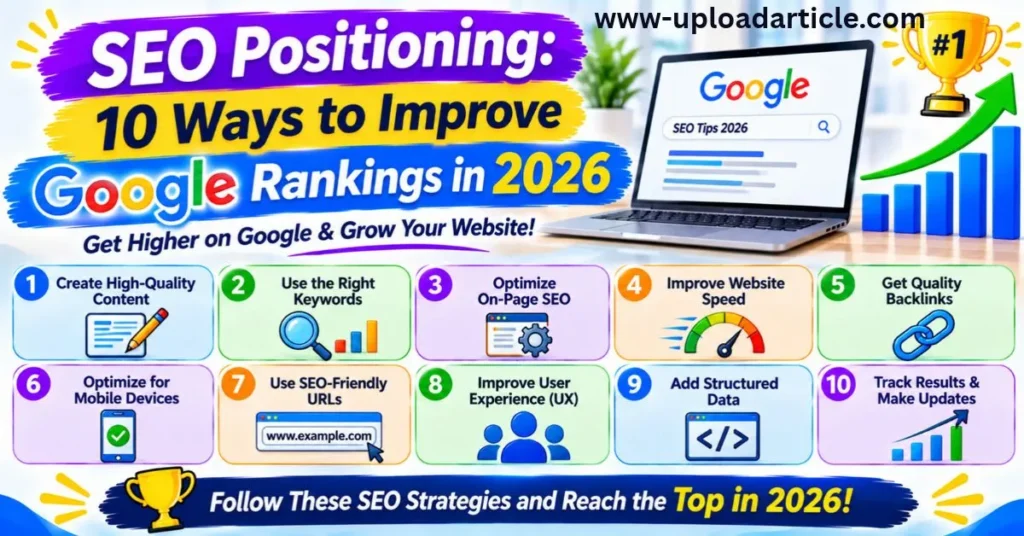
Getting a website noticed online is an important goal for businesses, bloggers, digital marketers, and website owners. Millions of web pages compete for attention in search engine results, making it increasingly important to understand how websites appear when people search for information, products, and services. A website may contain valuable information, but if its pages do not appear for relevant searches, potential visitors may never discover it. This is where SEO positioning becomes important.
SEO positioning refers to the visibility and placement of a website or individual web page in organic search engine results for specific search queries. It focuses on improving where a page appears when users search for relevant keywords. For example, if someone searches for “best digital marketing strategies,” a website appearing among the first organic results has stronger search positioning for that query than a website appearing much further down the results.
Good SEO positioning is not achieved through a single technique. It requires keyword research, helpful content, technical optimisation, relevant backlinks, internal linking, and a positive user experience. Search engines evaluate numerous signals when deciding which pages to show, and their systems continue to evolve.
In this guide, you will learn what SEO positioning means, how it works, why it matters, and which strategies can help improve your website’s organic search visibility in 2026.
What Is SEO Positioning?
SEO positioning is the process of improving a website’s placement in organic search engine results for relevant keywords and search queries. It involves optimising website pages so that search engines can understand their content and consider them relevant to users’ searches.
For example, imagine a business offers professional SEO services. When potential customers search for “SEO agency for small businesses,” the company wants its service page to appear among the relevant organic results. Improving the page’s content, technical quality, relevance, and website authority can support better positioning.
SEO positioning is closely connected to search engine optimisation, but the two terms describe slightly different concepts. SEO is the broader practice of improving a website for organic search, while SEO positioning focuses more specifically on where the website appears for selected search queries.
It is important to understand that search positions are not permanent. Rankings can change because of search engine updates, competitor improvements, content changes, and differences in search context. Therefore, SEO positioning should be treated as an ongoing process rather than a one-time task.
What Is Search Engine Positioning?
Search engine positioning describes the placement of a website or page within a search engine results page, commonly known as a SERP. When someone enters a query into Google or another search engine, the platform displays a range of results that may include organic listings, advertisements, local results, videos, images, and other search features.
A page’s organic position generally refers to where its unpaid listing appears among the organic search results. A higher position can increase the opportunity to receive clicks, although actual traffic also depends on search intent, titles, descriptions, competition, and the layout of the results page.
For example, a page ranking in the first few organic positions for a relevant commercial keyword may attract potential customers who are actively researching a product or service. A page ranking much lower may receive fewer clicks, even if its content is useful.
Search engine positioning is therefore about more than achieving a high number in a ranking report. The real objective is to appear for searches that are relevant to your website and bring visitors who are likely to benefit from what you offer.
Why Is SEO Positioning Important?
SEO positioning plays an important role in digital marketing because it helps businesses and websites become easier to discover through search engines. When a page appears for relevant queries, it has an opportunity to attract visitors who are already interested in the topic, product, or service.
One major benefit is increased organic visibility. Websites with stronger positioning for relevant keywords can reach audiences without relying entirely on paid advertisements. This can help businesses develop a consistent source of website traffic over time.
Another advantage is improved brand awareness. Users who repeatedly discover a brand while researching related topics may become more familiar with its products, services, and expertise. Useful content and a professional website experience can help strengthen that impression.
SEO positioning can also support lead generation and sales. For example, a company ranking for relevant service-related searches may attract visitors who are comparing providers or looking for professional assistance. When the landing page clearly explains the service and provides an effective next step, some visitors may become enquiries or customers.
For bloggers and publishers, better positioning can increase readership and help more people discover informative articles. For online stores, it can improve the visibility of product and category pages. The benefits depend on choosing relevant keywords and providing pages that satisfy the needs behind those searches.
How Does SEO Positioning Work?
SEO positioning works through the way search engines discover, process, and rank web pages. Search engines use automated crawlers and ranking systems to understand online content and select results for individual queries.
The process begins with crawling. Search engine crawlers discover pages by following links and using other discovery methods, including submitted sitemaps. A well-organised website with accessible pages and clear internal links can make important content easier to discover.
After crawling, search engines may process and index the information they find. Indexing involves analysing page content and storing information that can be used when responding to searches. A discovered page is not automatically guaranteed to appear in the search index.
When someone searches for a particular phrase, search engines evaluate relevant indexed pages and select results they consider appropriate. Their systems consider many factors, including content relevance, usefulness, page experience, website context, and other ranking signals.
For website owners, the objective is to create accessible, informative, trustworthy pages that satisfy search intent. There is no guaranteed way to secure a specific position, but consistent SEO improvements can help pages compete more effectively.
10 Effective Strategies to Improve SEO Positioning
Improving SEO positioning requires a combination of research, content development, technical improvements, and performance analysis. The following strategies provide a practical starting point.
1. Conduct Effective Keyword Research
Keyword research is one of the foundations of SEO positioning. It helps website owners understand the phrases people use when searching for information, products, and services. Choosing relevant keywords gives each page a clear subject and helps align content with user needs.
Start by identifying the main topics related to your website. Then research specific search phrases, related terms, and questions your audience may use. Consider search volume, competition, relevance, and search intent when deciding which keywords to target.
For example, a digital marketing agency might target phrases such as “SEO services for small businesses,” “local SEO agency,” and “website optimisation services.” These keywords represent different customer needs and may require separate landing pages.
Avoid targeting too many unrelated keywords on one page. Each important page should have a clear focus, while related topics can be covered through supporting articles and internal links.
2. Create High-Quality and Helpful Content
Content quality is essential for long-term search visibility. Search engines aim to provide users with results that are relevant and useful, so website owners should focus on producing original content that genuinely answers questions.
Start by understanding what people expect to find when they search for a keyword. If someone searches for a beginner’s guide, they probably need clear explanations and practical examples. If they search for a service, they may want pricing information, features, benefits, and contact details.
Organise content with descriptive headings, short paragraphs, useful examples, and relevant supporting information. Avoid unnecessary repetition and do not add words simply to make an article longer.
Review important pages regularly to correct outdated information and improve sections that no longer satisfy user needs. Helpful content should be written primarily for people, with SEO used to make it easier to discover.
3. Optimise On-Page SEO Elements
On-page SEO involves improving individual website pages so that visitors and search engines can understand them. It includes page titles, headings, content structure, URLs, images, and internal links.
Write a clear title that accurately describes the page and naturally includes its main keyword when appropriate. Use a descriptive H1 heading and organise supporting information under relevant subheadings.
Image optimisation is another useful practice. Give images meaningful file names, write descriptive alternative text where appropriate, and use suitable image formats and dimensions to support performance.
Internal links should connect related pages and help visitors explore additional information. For example, an article about SEO positioning could link to supporting guides about keyword research, technical SEO, and on-page optimisation.
These improvements help create a clear and organised website while making individual pages more relevant to their intended topics.
4. Improve Technical SEO
Technical SEO focuses on making a website accessible, understandable, and easy to use. Technical problems can prevent search engines from discovering important pages or create difficulties for visitors.
Check whether important pages can be crawled and indexed. Review your robots.txt file, XML sitemap, canonical tags, redirects, and noindex settings to identify potential problems.
Website performance also matters. Improve loading speed, reduce unnecessary scripts, optimise images, and use reliable hosting. Make sure navigation works properly and that visitors can access important information on mobile devices.
For larger websites, a logical URL structure and organised internal linking system can help search engines understand how pages relate to one another. Technical SEO should be reviewed regularly, especially after website redesigns, migrations, or major content changes.
5. Build Relevant and High-Quality Backlinks
Backlinks are links from other websites that point to your pages. They can help search engines understand relationships between websites and may contribute to how they evaluate a page’s reputation and authority.
However, backlink quality and relevance matter more than simply collecting large numbers of links. A relevant link from a respected industry publication may be more valuable than many unrelated links from low-quality websites.
Businesses can earn backlinks by publishing original research, creating useful guides, sharing expert insights, contributing to relevant publications, and building genuine relationships with other website owners.
Avoid manipulative link schemes, automated link-building networks, and large-scale purchases of links intended to influence rankings. Focus on earning links because your content provides genuine value to another website’s audience.
6. Strengthen Internal Linking
Internal linking connects pages within the same website. It helps visitors move between related resources and allows search engines to discover pages and understand their relationships.
A well-planned internal linking structure can improve website navigation and support the organisation of topical content. For example, a main SEO guide could link to supporting articles about keyword research, local SEO, on-page SEO, and technical optimisation.
Use descriptive anchor text that explains what visitors will find after clicking. Avoid vague phrases when a more meaningful description is possible.
Make sure important pages are accessible through relevant links and do not leave valuable content isolated. Internal linking is particularly important for websites with many articles, categories, and service pages.
7. Focus on Search Intent
Search intent refers to the purpose behind a user’s search query. Understanding it is essential because a page may target the correct keyword but still fail to satisfy what the searcher wants.
Search intent is commonly grouped into four categories:
- Informational intent: Users want to learn something or find an answer.
- Navigational intent: Users want to find a specific website or brand.
- Commercial investigation: Users are comparing products, services, or available options.
- Transactional intent: Users are ready to take an action, such as purchasing or booking.
For example, someone searching for “what is SEO positioning” probably wants an explanation, while someone searching for “SEO agency pricing” may be comparing service providers.
Create content that matches the purpose of each query. This improves relevance and helps visitors find the information or action they expect.
8. Improve Local SEO Positioning
Local SEO is especially valuable for businesses that serve customers in specific geographic areas. It helps companies become more visible in searches that include location names or imply local intent.
Start by maintaining an accurate Google Business Profile if your business is eligible. Include the correct business name, address or service area, phone number, opening hours, categories, and service information.
Create useful location pages when your business genuinely serves multiple areas. Include relevant information about your services and the locations you cover instead of publishing repetitive pages that provide little value.
Encourage genuine customer reviews and respond to feedback professionally. Consistent business information and a strong local presence can help customers discover and evaluate your company.
9. Monitor SEO Rankings and Website Performance
You cannot improve SEO positioning effectively without understanding how your website currently performs. Regular monitoring helps identify pages that are gaining visibility, losing rankings, or attracting visitors for unexpected queries.
Google Search Console is a useful starting point. It provides information about search impressions, clicks, average positions, click-through rates, and indexing issues.
SEO platforms can provide additional keyword tracking, competitor analysis, backlink information, and technical auditing features. Choose tools based on your website’s size and requirements rather than paying for features you do not need.
Track important keywords over time, but do not rely on a single ranking position as the only measure of success. Search results can vary by location, device, personalisation, and search features.
Also review organic conversions, leads, and sales. The ultimate goal is not simply to improve rankings but to attract relevant visitors who contribute to your website’s objectives.
10. Update and Improve Existing Content
Publishing new articles is useful, but improving existing pages can also support better SEO positioning. Over time, information can become outdated, competitors can publish stronger resources, and customer expectations can change.
Review pages that have lost clicks or impressions, contain outdated details, or no longer answer important questions. Improve weak sections, add relevant examples, update statistics when reliable information is available, and correct technical or formatting problems.
Do not change content simply to make it appear fresh. Updates should provide meaningful improvements to accuracy, clarity, relevance, or usefulness.
For websites with many articles, prioritise pages that already receive search impressions or have business importance. Improving these pages may provide a more practical starting point than creating large numbers of new articles.
SEO Positioning vs SEO Ranking: What Is the Difference?
SEO positioning and SEO ranking are closely related terms, and they are often used interchangeably. Both refer to where a website or web page appears in search engine results for a particular query.
However, SEO positioning is often used more broadly to describe a website’s overall visibility and placement across a group of relevant keywords. SEO ranking may refer more specifically to the position of an individual page for a particular search query.
For example, a website may rank in position three for one keyword, position seven for another, and position fifteen for a third. Its overall SEO positioning reflects how well it performs across the search queries that matter to its audience.
Both concepts are useful when analysing organic search performance. Website owners should look beyond individual rankings and consider visibility, traffic quality, conversions, and the relevance of the keywords being targeted.
SEO Positioning vs Paid Search Advertising
SEO positioning focuses on improving a website’s presence in organic search results. Paid search advertising involves paying for sponsored placements that appear in search engine results.
With SEO, businesses invest in content, technical optimisation, and website improvements to earn organic visibility. These efforts may take time, but successful pages can continue attracting visitors without requiring payment for each click.
With paid search, advertisers create campaigns and pay according to the advertising platform’s pricing model. Paid campaigns can provide visibility quickly, but results usually depend on an active budget.
| Comparison | SEO Positioning | Paid Search Advertising |
|---|---|---|
| Search placement | Organic results | Sponsored results |
| Payment | No payment per organic click | Advertising costs apply |
| Timeframe | Usually longer-term | Can provide quick visibility |
| Main investment | Content, expertise, and optimisation | Campaign budget and management |
| Traffic continuity | Can continue after active work | Usually declines when campaigns stop |
| Best use | Sustainable organic visibility | Immediate promotional reach |
Many businesses combine SEO and paid search to support different marketing goals. Paid campaigns can provide short-term exposure while SEO builds long-term organic visibility.
Common SEO Positioning Mistakes to Avoid
Even businesses that invest time and money in SEO can struggle when they rely on outdated techniques or ignore the needs of visitors. Avoiding common mistakes can help create a more sustainable strategy.
Targeting irrelevant keywords: High search volume does not automatically make a keyword valuable. Focus on searches that match your products, services, and audience.
Keyword stuffing: Repeating the same phrase unnaturally can make content difficult to read. Use keywords naturally and cover related concepts where they genuinely belong.
Publishing duplicate or thin content: Pages should provide distinct value. Avoid creating multiple pages that repeat almost identical information without serving different user needs.
Ignoring technical problems: Incorrect indexing settings, broken links, and poor website structure can make important pages harder to discover.
Building low-quality backlinks: Unrelated or manipulative links can create risks. Prioritise relevance and genuine editorial value.
Expecting immediate rankings: SEO requires research, implementation, and ongoing improvements. There is no guaranteed timeline or ranking position.
Focusing only on rankings: A high position for an irrelevant keyword may not produce useful visitors or sales. Measure the business value of organic traffic as well.
How Long Does It Take to Improve SEO Positioning?
There is no fixed timeline for improving SEO positioning. Results depend on several factors, including website age, competition, content quality, technical health, backlink profile, search intent, and the difficulty of the targeted keywords.
A new website competing in a highly competitive industry may need substantial time and consistent work to develop search visibility. A well-established website with relevant content and a strong technical foundation may see improvements more quickly after targeted optimisation.
Some technical corrections can improve crawling or indexing conditions relatively quickly, but that does not guarantee immediate ranking changes. Content improvements and authority development often require sustained effort.
Instead of expecting a particular ranking within a fixed number of days, set realistic performance goals. Monitor impressions, clicks, organic traffic, relevant keyword positions, and conversions over time.
Best Tools to Track SEO Positioning
SEO tools help website owners understand search performance, discover keyword opportunities, analyse competitors, and identify technical issues.
Google Search Console: Provides information about how a website appears in Google Search, including queries, impressions, clicks, average positions, and indexing reports.
Google Analytics 4: Helps analyse website traffic, visitor behaviour, and conversions. It can provide useful context about what visitors do after arriving through organic search.
Ahrefs: Offers keyword research, backlink analysis, competitor research, and rank-tracking features.
Semrush: Provides SEO research, keyword analysis, competitor insights, site audits, and position tracking.
Screaming Frog SEO Spider: Helps analyse website URLs, page titles, headings, redirects, broken links, and other technical SEO elements.
Bing Webmaster Tools: Provides search performance and website diagnostic information for Bing.
Start with free tools where possible. As your website and SEO requirements grow, you can consider paid platforms that provide the additional features you actually need.
Conclusion
SEO positioning is an important part of building a successful online presence. It focuses on improving where your website appears in organic search results for relevant keywords and helping potential visitors discover your content, products, and services.
Achieving stronger search visibility requires more than adding keywords to a page. It involves understanding search intent, creating useful content, improving technical SEO, building relevant backlinks, organising internal links, and monitoring performance.
Businesses should also remember that search rankings can change over time. A sustainable approach focuses on providing value to users, maintaining a technically sound website, and improving important pages consistently.
Whether you operate a blog, online store, local company, or professional service website, a well-planned SEO positioning strategy can help you attract relevant organic traffic and support long-term digital marketing goals.
FAQs
What does SEO positioning mean?
SEO positioning refers to the placement and visibility of a website or web page in organic search engine results for specific keywords or search queries. The goal is to improve visibility and attract relevant visitors.
How can I improve my SEO positioning?
You can improve SEO positioning through keyword research, helpful content, on-page optimisation, technical SEO, internal linking, relevant backlinks, local SEO, and regular performance monitoring.
What is the difference between SEO and SEO positioning?
SEO is the broader practice of improving a website for organic search visibility. SEO positioning focuses more specifically on where the website or its pages appear for relevant search queries.
Why is SEO positioning important?
It helps businesses become more visible in search results, attract relevant website visitors, increase brand awareness, and create opportunities for leads and sales.
How do I check my website’s SEO positioning?
Google Search Console provides average position data for queries and pages that appear in Google Search. Dedicated SEO platforms can also track selected keywords and compare search visibility over time.
What factors affect SEO positioning?
Factors include content relevance and usefulness, search intent, technical accessibility, internal linking, website experience, backlinks, and the overall context of the search query. Search engines use many signals, and no single factor guarantees a ranking.
Is SEO positioning free?
Organic search listings do not charge website owners for each click. However, improving SEO positioning may involve costs for content creation, website development, SEO tools, technical work, and professional services.
How long does it take to rank higher on Google?
There is no guaranteed timeline. Results depend on competition, website quality, keyword difficulty, content relevance, and the work required to improve the site. SEO generally requires ongoing effort.
What is keyword positioning in SEO?
Keyword positioning refers to where a specific web page appears in search results for a particular keyword or search query. It is commonly monitored to understand changes in organic search visibility.
Can SEO positioning increase sales?
Yes. Strong positioning for relevant commercial and transactional searches can attract potential customers who are researching products or services. However, sales also depend on the quality of the offer, website experience, pricing, trust, and conversion process.